


Mailer Box Packaging Guide: Specifications, Materials, Load Capacity, and Applications
Mailer boxes are a very popular type of corrugated box. They are made for safe, efficient, and cost-effective shipping of products. These boxes are usually made from a single piece of die-cut corrugated board. They have a self-locking tuck-top design, so no extra glue or outer packaging is needed.
Mailer boxes are carefully designed to be strong and accurate in size. They are built to handle common shipping stresses, such as stacking, shaking, and impacts.
Contrary to traditional slotted shipping cartons, mailer boxes offer:
- Increased structural stiffness by use of folded panels
- Enhanced product display without secondary packaging
- Optimized dimensional weight efficiency for courier services
Mailer boxes are often used for mailing or shipping purposes:
- Apparel and fashion accessories
- Subscription
- Cosmetics and personal care products
- Electronics
- Dry goods and Non-perishable items
Mailer boxes are very adaptable and come in different material grades, flute strengths, and sizes to hold products of various weights and shipping conditions. Knowing these technical details is important to choose the right box for your needs.
This mailer box packaging guide explains the specifications, materials, and load capacities of mailer boxes. It helps companies pick boxes based not just on looks or design, but on how well they function.
Mailer Box Structural Specifications
The structure of a mailer box determines how it is designed and built to protect products during storage and shipping. Unlike regular slotted cartons, mailer boxes close and support themselves without needing glue or tape.
- 1. Box Style and Die-Cut Configuration
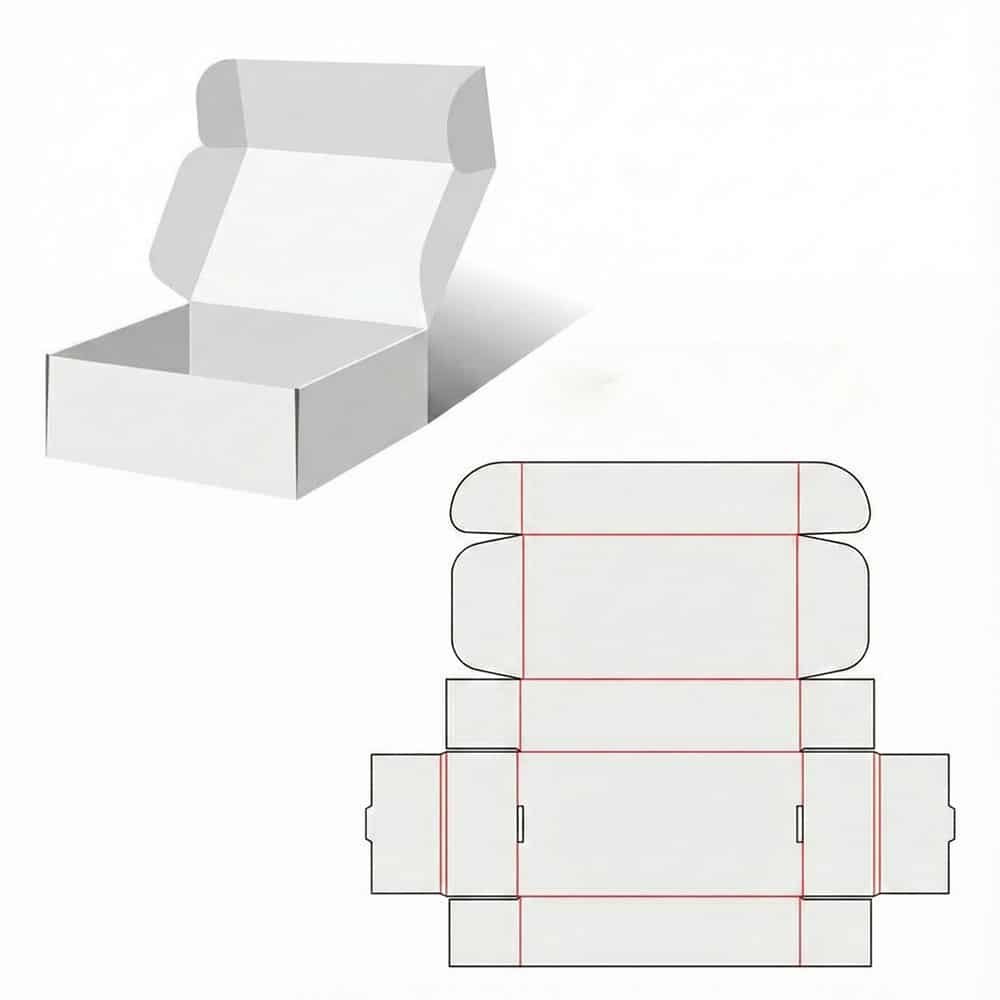
Mailer boxes are made from a single piece of corrugated board. The entire box is cut from one sheet using a steel die. This design provides for:
- Standardized production, as all boxes are similar.
- Panel alignment adjustment
- Uniform Load Distribution
- Assembly without any tools or adhesives, and
The die-cut layout consists of:
- Top and bottom panels
- Side walls
- Front and rear tuck flaps
- Locking tabs and slots
Since the box is pre-designed with a die, its size is very accurate. It can also be reproduced consistently, much more reliably than boxes that are assembled by hand.
- Roll End Front Tuck (REFT) Design
The most popular type of mailer boxes’ structural design is the Roll End Front Tuck (REFT).
Key structural features of REFT mailer boxes:
- Front tuck flap rolls inward to lock into the side panels
- Double-layer corrugated walls for the front and rear panels
- Stiffness at the stressed areas
- Increased resistance to crushing and deformation
The box’s design strengthens the edges around the opening. This reinforcement helps the box handle the constant stress of shipping.
- 3. Self-Locking Closure
Mailer Boxes have a mechanical lock system instead of using tapes. The mechanical lock system has the following components:
- Die-cut locking tabs
- Corresponding slots or channels
- Engagement
Strengths of self-locking closures:
- Reduces risk associated with adhesive failure
- Box maintains integrity in vibration & impact
- Facilitates tool-free assembly in a fulfillment center
- Facilitates opening without damaging the box
From a technical perspective, the locking tabs also help the box resist side-to-side pressure, especially when boxes are stacked.
- 4. Panel Geometry and Load Distribution
The strength of a Mailer box not only relies on materials but also on geometry.
Structural performance is improved by:
- Folded double-wall side panels
- Reinforced Corners formed by Overlapping Flaps
- Even load transfer between the top panel and the side walls
This geometry ensures that forces. Such as vertical loading (weight of the stack) are easily transferred to the base of a box to prevent buckling of panels.
- 5. Edge and Corner Reinforcement
Edges and corners are considered the main stress concentration factors in corrugated packaging. A mailer box can capture these benefits through:
- Rolled edges that occur when folding
- Multi-layer board thickness at corners
- Tight die tolerance to eliminate loose joints
These reinforcements affect the following:
- Drop resistance
- Edge Crush Resistance (ECR
- Overall box compression strength (BCT)
- 6. Specifications for Flat-Pack and Assembly
Mailer boxes are shipped flat, which offers several benefits regarding logistics:
- Smaller storage capacity
- Reduced costs of ·Increased packing speeds
The assembly may comprise:
- Raising the side walls
- Locking base flaps into position
- Inserting the front tuck flap
Average assembly time is under 10 seconds for a box, which makes mailer boxes ideal for large volume fulfillment centers.
- 7. Structural Tolerances and Manufacturing Precision
The manufacture of Mailer boxes calls for strict tolerance to facilitate locking and loading.
Typical tolerance values are:
- ±1-2 mm in small to medium sizes
- ±2-3 mm for large format mailer
Poor tolerance control may lead to:
- Weak locking engagement
- Misaligned
- Loss of load-bearing
Thus, quality die tooling and cutting machines are needed.
Mailer Box Material Specifications
A mailer box will perform depending on the type of material that it is made of. The material used affects not only the strength and weight capacity of the box. But also other factors like print quality and shipping efficiency. These points are important when choosing the right type and size of mailer box.
- 1. Corrugated Board
Mailer boxes are manufactured using corrugated fiberboard as their raw material. This is made up of three layers:
- Outer Linerboard or Outer SBR Linerboard – Gives strength to the surfaces,
- Fluted Medium- It has a wavy layer, which acts as a cushion. It provides compression resistance.
- Inner linerboard: This contributes to the internal strength of the package.
The fluted core serves as a shock absorber, while the linerboards distribute the loads evenly on the surface of the box.
- 2. Linerboard Types Used in Mailer Boxes
The linerboard has a direct influence on the tensile strength, tear resistance, and appearance of the box.
Kraft Linerboard
- Made from virgin wood pulp
- High fiber strength and
- Natural Brown Color
- Very resistant to tears & punctures
Best suited for:
Heavy products, freight transportation over long distances, and environmental packaging concerns
White Linerboard
- Usually bleached or coated
- Smooth surface for printing
- Slightly lower strength compared to ‘kraft’ paper. However
Best Suited For:
Retail Packaging, Brand-centered Mailer boxes, Luxury Presentation boxes
- 3. Single Wall vs Double Wall Mailer boxes
They are generally made from single-wall corrugated material. But a heavier wall thickness may be necessary for certain applications.
Construction Type | Structure | Typical Use |
Single-Wall | 1 fluted medium + 2 linerboards | Most e-commerce mailer boxes |
Double-Wall | 2 fluted mediums + 3 linerboards | Heavy or fragile products |
- 4. GSM and Board Thickness Standards
GSM stands for Grams per Square Meter, which is an important measure of density.
Typical GSM values for Mailer Boxes:
- Linerboard: 125–300 GSM
- Fluted medium: 110–180 GSM
- Combined board thickness: 1.2 mm to 5 mm (depending on flute type)
A higher GSM always corresponds to:
- Increased compression strength
- Increased puncture resistance
- Higher material cost
However, if GSM were to be used in excess without the proper flutes, the results could be diminishing returns.
- 5. Material Strength Properties
Mailer box materials will be judged for the following mechanical properties:
- Edge Crush Resistance (ECT) – Resistance to vertical compression
- Burst Strength (Mullen Test) – Resistance to internal pressure
- The tear resistance required by a polymer depends on the strength of the tear applied. It is Bending Stiffness – Resistance to panel deformation. These factors, both individually and together, determine how well a mailer box will perform during stacking, shipping, and handling.
- 6. Moisture Resistance and Environmental Performance
Corrugated materials are moisture-sensitive and may experience a loss of strength of up to 50% in a humid environment.
Advances in manufacturing technology may provide the following approaches for better moisture properties:
- Moisture-resistant kraft liners
- Water-based
- Wax or polymer barriers (for special uses)
Material selection should take into consideration:
- Climate factors
- Storage duration
- Shipping
- 7. Sustainability and Material Certifications
Material specifications also have an important role in environmental regulation.
Sustainability qualities may include:
- Recyclable corrugated fiberboard
- FSC-certified linerboard
- Use of post-consumer recycled content
- Water-based inks and coating
Mailer boxes made from eco-friendly materials help reduce the environmental impact. environment
- 8. Materiel Selection based on Product Requirements
The selection of appropriate material depends on several factors, which include:
- Product weight, Fragility
- Loader capability for
- Shipping distance and handling intensity
- Branding or print quality requirements
- Sustainability
The choice of material relying entirely on aesthetic appeal may lead to a structure collapsing or incurring additional expenses unnecessarily.
Corrugation & Flute Types Used in Mailer Boxes
Corrugation plays a key role in the strength, cushioning, thickness, and load capacity of a mailer box. The corrugated flute is the wavy paper layer between the liner boards. It acts as the core that absorbs shock and resists compression.
Choosing the right flute is important. It ensures good performance while avoiding extra material costs.
- 1. What Is a Corrugated Flute
A corrugated flute has a paper wave-like structure bonded between the linerboards. The flute functions as:
- Vertical compression resistance
- Shock absorption during handling
- Rigidity and bending stiffness
- Thermal and Vibration Cush
Each type of flute will also have a different height, frequency of flutes per foot, and thickness. These will directly affect the characteristics of a box.
- 2. E-Flute Specifications for
E-Flute is the most prevalent type of flute used in mailer boxes. As it offers a good balance between strength, thickness, and print quality.
Technical Characteristics:
- Flute height: ~1.0–1.6 mm
- Flutes per foot: ~90
- Board thickness: ~1.2–1.8 mm
Performance Benefits:
- The smooth surface allows for high-quality printing.
- Compression resistance: Good for lightweight to medium products
- Reduced shipping dimensional weight
Typical Applications:
- Cosmetic and care products
- Apparel and accessories
- Subscription boxes
- Small Electronics and Accessories
E-Flute is ideal when presentation, cost efficiency, and shipping optimization are key considerations.
- 3. B-Flute Specifications
B-Flute has the added benefits of strength and cushioning over E-Flute, but it is still rather thin.
Technical Characteristics:
- Flute height: ~2.5–3.0 mm
- Flutes per foot: ~50
- Board thickness: ~2.8–3.5 mm
Benefits for Performance:
- Higher load-carrying capacity
- Better puncture and impact resistance
- Improved stacking strength
Typical Applications:
- Heavier items in e-commerce
- Glassware and fragile products
- Multi-item shipments
B-flute is used when the protection of the product is more important than the smoothness of the print.
- 4. C-Flute Specifications:
C-Flute corrugation is mostly used in heavy-duty shipping cartons. It can also be used in mailer boxes that need to handle very heavy loads.
Technical Characteristics:
- Flute height: ~3.5–4.0 mm
- Flutes per foot: ~40
- Board thickness: ~3.5–4.5 mm
Performance Advantages:
- Great cushioning performance and shock absorption
- High compression strength
- Optimal load distribution
Typical Applications:
- Bulk or heavy items
- Long-distance transport, rough handling, and
C-Flute can add weight to the DIM due to the thickness of the C-Flute material. Thus, C-Flute may not be ideal in standard DTC mailers.
- 5. Flute Type Comparison Table
Flute Type | Thickness | Load Capacity | Print Quality | Best Use Case |
E-Flute | Thin | Medium | Excellent | Lightweight e-commerce & retail |
B-Flute | Medium | High | Good | Fragile or heavier products |
C-Flute | Thick | Very High | Fair | Heavy-duty or industrial shipping |
- 6. Impact of Flute Selection on Load Capacity
Flute selection directly impacts:
- Edge Crush Resistance (ECT)
- Box Compression Strength (BCT
- Stackability during storage
- Resistance to deformation under pressure
An improperly selected flute may cause:
- Slide or box collapse during
- Product damage
- Return on sales
Accordingly, the selection of the flute should be based on the weight of the product being shipped, as well as the handling process.
- 7. Flute Selection Guidelines for Mailer Boxes
General technical recommendations:
- Up to 2 kg: E-Flute
- 2–5 kg: B-Flute
- 5 kg and above: C-Flute or double-wall
Other things to consider when choosing flute types include environmental factors. Like humidity and how high the boxes will be stacked.

Mailer Box Load Capacity & Strength Analysis
“Load capacity” is one of the most essential technological properties of a mailer box. “Load capacity” determines how much weight it will be able to handle and protect during storage and shipping. “Load capacity” is not a matter of material thickness; it is a function of material type and structure.
- 1. Understanding Load Capacity in Mailer Boxes
Mailer box loading capacity is defined by the maximum weight that the box is capable of withstanding without its failure.
Mailer box loading capacity parameters:
- Weight
- Compression force
- Product weight inside the box
- Additional stacking weight during storage or transit”
- Dynamic forces due to drops, vibration, and manipulation
A properly functioning mailer box must provide resistance against both static loads and dynamic loads.
- 2. Key Strength Metrics in Corrugated Packaging:
Two common tests measure the strength of mailer boxes.
- 3. Edge Crush Test (ECT):
The Edge Crush Test measures how much compressive force a corrugated board can withstand. When pressure is applied to its edge.
What does ECT imply?
- Resistance to vertical compression
- Ability to support stacking loads
- Structural integrity of the corrugated medium
Normal ECT Grades for Mailer Boxes:
- E-Flute: 23–32 ECT
- B-Flute: 32–44 ECT
- Double-Wall: 48+ ECT
Higher ECT values show the greater strength of stacking. And making them suitable for heavier products or palletized shipments.
- 4. Box Compression Test (BCT)
The Box Compression Test (BCT) measures the maximum compressive load. That a box can withstand before collapsing.
The things that influence BCT include:
- Board ECT rating
- Box dimensions
- Type of flute
- Structural design (REFT – reinforced panels)
Simplified BCT Formula (McKee Formula):
BCT ≈ 5.87 × ECT × √(Perimeter × Thickness)
This equation offers a value of the load capacity under ideal conditions.
- 5. Static vs Dynamic Load Conditions
Static Loads
- Weight applied when boxes are stacked
- Occurs in the warehousing and pallets
- High Compression Strength is Required
Dynamic Load
- Forces from drops, vibration, and movement
- Occurs in the transporting and handling of shipments by
- Needs to be impact-resistant and cushioned
Mailer boxes have to be designed to withstand both of these factors at once.
- 6. Impact of Box Dimensions on Load Capacity
The size of the box affects strength performance.
- Taller boxes possess lower compression strength
- Larger panels are more likely to buckle
- Oversized boxes decrease the stack ability
Optimal dimensioning leads to better load-carrying capacity and freight cost optimization.
- 7. Environmental Factors That Influence Strength
Exposure to the environment can greatly reduce the strength of corrugated boxes.
- Humidity can lower strength by up to 50%.
- Long storage times can cause the board to slowly deform, a process called creep.
- Changes in temperature can weaken the adhesive bonds.
In the case of a humid or long-distance shipping route, a higher grade of ECT is recommended.
- 8. Load Capacity Guidelines by Product Weight
These parameters need to be varied according to the stack height and the mode of shipping.
Product Weight | Recommended Flute | Typical ECT |
Up to 2 kg | E-Flute | 23–32 |
2–5 kg | B-Flute | 32–44 |
5–10 kg | C-Flute / Double-Wall | 44–55 |
- 9. Safety Factors in Load Capacity Design
- A safety factor is introduced because of actual variations.
- Usual safety coefficient: between 3 and 5
- Increased safety factors for long-range transit or export shipments
- Lower safety factors for short-distance DTC transport
If not enough safety margins are considered in the design, there is a possibility that the box and the product might not function properly.
- 10. Common Load Capacity Calculation Errors to Avoid
- Flute selection based on its appearance of strength
- Over-size boxing, additional panel vulnerability
- Ignoring humidity and storage conditions
- Use of low ECT boards for stacked shipments. This is usually reflected in terms of collapsed boxes, returns, and logistics costs.
Dimensional Standards & Measurement Guidelines
Accurate sizing is very important in mailer box design. The dimensions affect load capacity, how well the product fits, material use, and shipping costs. Wrong sizes can make the box weak, increase shipping charges, and raise the risk of product damage.
- 1. Knowing Mailer Box Dimensions
The dimensions of a mailer box are specified in terms of internal measurements using the standard order:
L × W × H
- Length (L): The longest side of the opening
- The width is the width of an opening, or the shorter side.
- Height (H): The depth of the box from base to top
Internal dimensions determine usable space for the product and any protective inserts.
- 2. Internal versus External Dimensions
It is also important to make a difference between the internal and external dimensions:
- Internal dimensions define product fit
- External dimensions include board thickness and determine shipping cost
The external dimensions are always larger due to:
- Corrugated board thickness
- Overlap of folded panel
- Structural reinforcements.
In calculating shipments, couriers base their charges on outside dimensions.
- 3. Board Thickness Impact on Dimensions
Corrugated thickness varies by flute type:
Flute Type | Approx. Thickness |
E-Flute | 1.2–1.8 mm |
B-Flute | 2.8–3.5 mm |
C-Flute | 3.5–4.5 mm |
Thickness has to be added to the internal measurements in order to have the correct measurements for the outer size, especially in the case of a large box.
- 4. Dimensional Weight (DIM)
Many courier companies use the DIM weight system rather than the weight for calculating the charges for delivery.
DIM Formula (Typical):
DIM Weight = (Length × Width × Height) / DIM Factor
Oversized mailer boxes lead to higher dimensional weight, which increases postage cost even when handling lightweight items.
- 5. Size Optimization for Structural Performance
Size optimization leads to increased strength as well as improved efficiency.
Best practices are:
- Reducing the empty space inside the box
- Avoiding excessive height
- Balanced proportions
- Using inserts instead of oversizing
A box containing too much empty space can cause panel distortion and box collapse.
- 6. Standard vs Custom Mailer Box Sizes
Standard Sizes
- Faster availability
- Reduced cost for smaller quantities
- Limited product fit options
Custom Sizes
- Optimized Product Protection
- Lowered shipping cost
- Increased structural efficiency
- Higher initial cost of tools. Custom sizing will be beneficial in massive shipping operations.
- 7. Manufacturing Tolerances
The dimensions of a mailer box will also have tolerances, depending on how it is.
Typical Tolerance Ranges:
- Small to Medium Size Containers: ±1-2 mm
- Large boxes: ±2-3 mm
All designs have to take these tolerance values into account in order for the lock to engage and close properly.
- 8. Stack Height & Pallet Factors
Dimensions also influence:
- Pallet stacking patterns
- Storage efficiency
- Compression Loads on Bottom Boxes
“Optimized box height enables even loading and prevents the possibility of crushing when the boxes are palletized.”
- 9. Measurement Checklist for Mailer Boxes
Prior to finalizing the dimensions, check
- Product size and orientation
- Required protective clearance
- Board thickness
- Closure and locking allowance
- Courier DIM Requirements
Omitting these validation steps may lead to additional design work costs or inefficient shipping.
Conclusion
Mailer box packaging is more than just shipping a product. It is a careful balance of box structure, materials, corrugation type, weight capacity, and size. Sections 1 to 6 explain how all these parts work together to make a strong and reliable box.
The mailer box design, especially the roll end front tuck (REFT) style, is strong and secure. It locks in place without the need for glue or tape. The choice of material, such as linerboard type, thickness, and weight, affects durability, cost, and environmental impact.
Corrugation, also called flute type, plays a key role in strength. It helps the box resist pressure, stacking loads, and damage during handling. Tests like ECT and BCT help ensure the box stays safe during storage and transport.
Box size is just as important. Accurate internal dimensions and correct board thickness improve strength and control shipping costs. Boxes that are too large or poorly sized reduce performance, even if the materials are strong.
By using the technical principles explained in this guide, businesses can choose the right mailer boxes with confidence. This approach improves performance, lowers costs, and reduces product damage, instead of relying only on appearance or guesswork.
Frequently Asked Questions related to Mailer Box Packaging Guide
Q1. What is the most commonly used flute type for mailer boxes?
E flute is commonly used for mailer boxes as it is thin, has good compressive strength, excellent printability, and lower mass contribution to size, which makes it suitable for e-commerce applications.
Q2. How do I calculate or determine the load capacity of a mailer box?
You can calculate the load capacity of a box by looking at its ECT value, flute type, size, and design. The Box Compression Test helps estimate how much weight a box can handle when stacked. This test can be calculated using the McKee formula and gives a reliable measure of stacking strength.
Q3. Why is it more important to know the internal dimensions of an object rather than its external dimensions?
It is more important to know the internal dimensions of a box than the external ones. Internal dimensions ensure the product fits properly and stays protected. External dimensions are mainly used to calculate shipping and transportation costs.
Exact internal dimensions prevent movement, preserve structural efficiency, and reduce possible damage.
Q4. Can the mailer box be used for heavy items?
Mailer boxes can safely carry heavy products if the right materials are used. Choosing a strong flute, such as B-flute or C-flute, along with a high ECT board and a solid box design, makes a big difference. For very heavy items, using double-wall custom packaging provides extra strength and protection.
Q5. How will the humidity in the environment at the test site affect?
High humidity can greatly reduce the strength of corrugated boxes. In some cases, it can lower strength by up to 50%. For humid environments, it is best to use higher ECT grades and moisture-resistant materials.
Q6. ECT and BCT are what kinds of techniques?
ECT and BCT are strength testing methods. ECT measures how strong the board is when pressure is applied to its edge. BCT measures how much weight a fully assembled box can handle. ECT focuses on the material itself, while BCT shows how the box performs in real use.
Q7. What is so important about box height in dimension planning?
Box height plays a key role in strength and stacking. Taller boxes are usually weaker under pressure, even if they use the same material. At the same time, larger boxes weigh more. Choosing the right height helps improve stacking strength and makes shipping safer and more efficient.
Q8. Are custom-made mailer boxes superior to standard sizes?
Custom mailer boxes fit the product better and are more evenly loaded. They may cost more to set up, but for higher volume shipments, it is more efficient.