
Innovative Food Box Design: Elevating Leak-Proof Solutions with High-End Aesthetics
Today, the relationship between an innovative kitchen and a necessary dining table has grown far beyond simple food delivery. As expectations around luxury brands continue to rise, consumers now expect more than just a meal arriving from point A to point B. Because of this shift, modern food box designs have become a gold standard for brands that want to meet practical needs while also delivering a luxury “wow” factor.
The days of packaging being just a basic transport tool are gone. Today’s consumers expect a complete luxury experience. It is no longer enough to simply move a hot meal from a chef’s kitchen to a customer’s table. The custom packaging must now solve one of the biggest challenges in food delivery: preventing spills. At the same time, it must tell a visual and structural story through flow, shape, and form. The goal is a leak-proof seal that keeps food intact, avoids sogginess, and delivers a satisfying experience from start to finish.
This evolution is driven by major industry trends, especially sustainability and user experience. Organizations such as the Sustainable Packaging Coalition highlight that the future of packaging depends on combining environmental responsibility with high-performance engineering. When a customer interacts with an innovative food box design, they are holding a physical reflection of a brand’s quality standards. Because of this, packaging choices are now more important than ever for building long-term customer loyalty and standing out in a competitive market. What is your next step?
The Structural Geometry of Leak-Proofing
It is impossible to discuss innovative design without first addressing its basic foundation, especially its geometric strength and the way the lid and base interact under pressure. Traditional box designs often fail in this area because they rely on a single, direct point of contact. Modern, state-of-the-art designs instead use interference fits and groove-based systems that distribute pressure more evenly and improve overall performance.
In addition, architectural principles such as the use of a “tension arch” in lid design show a deeper understanding of structural behavior. This approach allows the box to maintain its shape even when stacked, preventing the sides from bowing outward instead of holding firm. Moving toward smarter and more engineered silhouettes is no longer optional. It is a necessity, especially as premium food delivery demands continue to rise and mechanical performance must be flawless.
Research from Smithers, a global authority in packaging efficiency, clearly supports this direction. Their findings highlight the importance of reinforced corners, strengthened radii, and ribbed perimeter elements to meet strict spill-proof requirements. These features remain essential regardless of whether food is delivered by motorcycle or bicycle.
Innovative food box design can also include internal “wave breaks,” which are textured surfaces built into the base of the box. These textures help reduce the movement and force of liquids such as sauces or oils, preventing pressure from building against lid seams. By using these design strategies, brands can treat the innovative food box design as a form of micro-architecture rather than a simple container, creating a sense of security and luxury from the very first moment in the kitchen.
Material Aesthetics: Blending Eco-Friendly Substrates with High-Gloss Finishes
The innovative food box design reaches the customer the moment they touch it. This moment creates a direct connection between the material used and the overall box design. Because of this, choosing the right material is a key part of building a good innovative food box design. Traditional plastic made from petroleum is slowly being phased out because of environmental concerns. It is now being replaced with high-performance biopolymers and fiber-based materials that feel premium and comfortable to hold.
These modern innovative food box design often use water-based coatings that create smooth, non-grainy surfaces. The finish can be soft and matte or clean and glossy, depending on the brand’s needs. These finishes are not just for looks. They help protect the food inside and keep its quality intact. More importantly, these special surfaces repel water and oil. This creates an extra protective layer that supports a leak-proof innovative food box design.
Studies published in the Journal of Cleaner Production show that new cellulose-based fiber materials allow designers to create highly innovative food box design without losing strength or oil resistance. These materials make it possible to build boxes that are both strong and flexible in design, while still meeting high-performance standards.
Designers can also use interesting textures to enhance the experience. Materials like linen-embossed paperboard or added stone powders create a feeling of natural, earthy luxury. This appeals to modern, environmentally aware customers. The final result is a innovative food box design that does not feel like waste. Instead, it feels like part of the brand’s identity, just as the taste and flavors are meant to be part of that same story.
The Ergonomics of the Unboxing: Designing for Graceful Entry
A truly innovative food box design must consider how a human hand interacts with the mechanical seal. One common problem in high-security food packaging is the “suction-lock” effect. In this situation, the seal becomes so tight that the box is very hard to open. When a customer finally pulls it open, the sudden force can cause the food inside to spill.
To fix this issue, smart designers add pressure-release tabs and angled, or “canted,” edges. These features allow the lid to open with a smooth peeling motion instead of a strong, sudden pull. This small design choice turns a basic function into a pleasant moment and shows that the restaurant cares about customer comfort as much as food safety.
This type of human-focused engineering is supported by research from IDSA. Their studies explain that tactile feedback, such as a soft “click” sound or a smooth sliding motion, can greatly increase the perceived value of the packaging. Many innovative food box design also include recessed finger areas and balanced weight distribution. This helps prevent the container from tipping over when the lid is removed.
By carefully studying how the lid opens, designers can also control condensation. Instead of dripping onto the table or the customer’s lap, moisture is guided back into the base of the box. All of these details turn the simple act of opening a meal into a smooth, premium experience, similar to what one would expect in a five-star dining environment.
Color Theory and Branding: Using Visual Cues to Stimulate Appetite
Packaging quietly communicates a visual message. That can influence how customers feel about taste, temperature, and food quality, often without them realizing it. Color in the innovative food box design is not just decoration. It is a powerful tool used to create specific emotional and physical responses. Warm colors such as terracotta, deep ochre, and soft reds are known to increase appetite and create comfort. It makes them perfect for rich and satisfying meals.
On the other hand, cool colors or plain white tones can make food look dull or uninviting if they are not balanced with textured surfaces. Because of this, designers are moving away from the loud and neon colors commonly used in fast-food packaging. Instead, they are choosing refined, earthy tones that suggest freshness and quality.
Research published by Oxford University Press through the Crossmodal Research Laboratory shows that packaging color can even affect how sweet or salty food is perceived to be. This means color directly shapes the eating experience. By using dark interior linings inside innovative food box design. Designers can create a visual frame that highlights the food. Bright colors, such as the green of fresh vegetables or the orange of spicy dishes, stand out more clearly and look more appealing.
This “plating effect” helps turn the meal into a special moment rather than a simple takeaway. When these visual choices are combined with strong, leak-proof packaging, the result is a complete experience. It pleases both the eyes and the taste buds. It transforms an everyday food order into a premium and memorable brand experience.
Modular Systems: Designing Food Boxes for Multi-Course Delivery
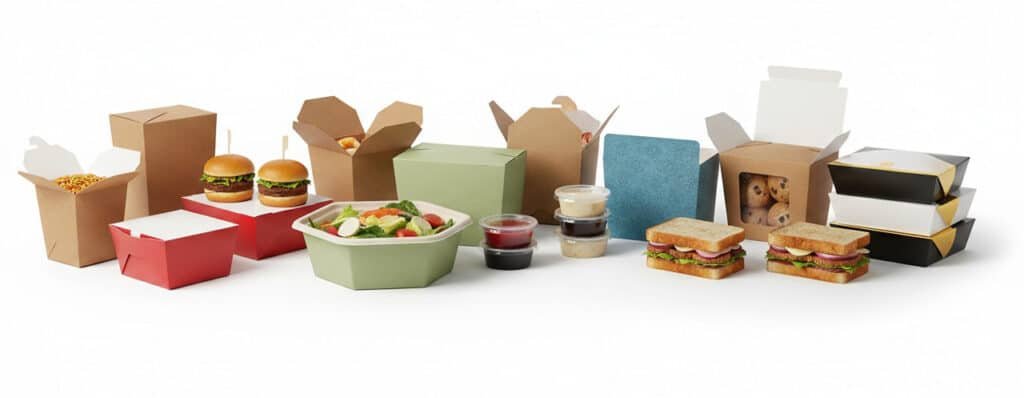
The shift toward multi-course dining at home has created the need to move away from “one-size-fits-all” packaging. Instead, modern food packaging now relies on smarter, interlocking systems. Today’s advanced innovative food box design focus on modular layouts. These designs allow smaller, leak-proof containers for sauces or side dishes to fit neatly inside a larger main innovative food box design.
This nesting system helps prevent items from moving around during delivery. It is often the main reason seals fail. By using a “hub-and-spoke” structure, designers can place hot main dishes in the center. By keeping cold items like salads or desserts in outer compartments. This separation helps maintain both temperature and food quality. It has become a key feature of premium delivery services that aim to protect every ingredient.
According to ISTA, reducing empty space inside packaging lowers the risk of damage during transport. It also helps ensure that internal seals remain secure. When the package is exposed to side-to-side movement. This approach supports the strength and reliability of innovative food box design.
Many modular innovative food box design also include a stack-locking feature. In this design, the base of one box fits securely into the lid of another. This creates a stable stack that prevents boxes from tipping over during delivery. As a result, customers receive their meals in better condition. At the same time, delivery couriers benefit from improved efficiency. Especially when transporting meals made up of multiple courses.
The Digital Layer: Integrating QR and AR into Innovative Food Box Design
Today, the innovative food box design is more than just a container. In a digital world, the surface of the box is now an important space for brand interaction. When digital features are added to a innovative food box design. A simple package can become interesting and engaging. By placing a QR code inside the design of the box lid. Restaurants can connect with customers in useful and fun ways.
With one scan, customers can access music playlists, short chef videos, or information about the food ingredients. This makes the experience feel more personal and enjoyable. Digital design is not only about branding. It also helps solve real food delivery problems. For example, restaurants can show the temperature at which the food was packed. They can also explain how to open each layer of the box step by step, helping customers avoid spills or mess.
Research by the Active & Intelligent Packaging Industry Association (AIPIA) shows that smart packaging builds customer trust. When customers can see food safety details and supply chain information. They feel more confident about the brand. This transparency improves loyalty over time.
Digital features can also make the unboxing experience more fun. Customers may receive rewards, tips, or simple plating guides to arrange the food better at home. Even after the meal is finished. These digital touches help customers remember the restaurant’s quality and style.
Circular Design: Navigating the Conflict Between Leak-Proof Durability and Recyclability
Today, brands are working toward zero-waste packaging. In the past, making sealed packages that were also recyclable was very hard. Traditional packages used many layers: plastic to block moisture, aluminum to stop air, and paper for structure. These layers protected food well but were very hard to recycle because machines could not separate them.
New innovative food box design technology is changing this. Designers now use “mono-materials,” which means the whole box is made of one material, often strong polypropylene. Using a single material allows the box to have a tight, leak-proof seal and still go into a single recycling bin.
The Sustainable Packaging Coalition says that to make a real circular economy. We need to think differently about durability. Materials should stay strong and useful through many recycling cycles instead of becoming waste. Innovative food box design is also improving labels by using wash-off adhesives or laser-etched logos. This removes obstacles to clean recycling.
This “Cradle to Cradle” approach makes sure innovative food box design do not end up in landfills. They can go back to the factory and be made into new boxes again. This shows that eco-friendly packaging and strong, leak-proof performance can work together.
The Future of Customization: 3D Printing and On-Demand Innovative Food Box Design Solutions
We are entering a time when “one-size-fits-all” containers are going away. Instead, we now have “on-demand” containers that are carefully designed for specific foods. By using 3D printing in innovative food box design, this idea has moved from just a plan to real production. Small batches can now be made quickly using methods like Selective Laser Sintering (SLS) or Stereolithography (SLA). This lets designers create inside spaces that fit perfectly around shaped pastries or the layers in Bento boxes. At the same time, 3D printing allows for lids that fit exactly and are completely leak-proof. Without adding extra gasket material or creating waste.
According to a 2026 report from Fortune Business Insights, the food and beverage industry is the largest area for 3D printing in packaging. Food packaging needs to be strong and light while keeping food fresh. 3D printing is perfect for making complex shapes that help with this.
3D printing also lets restaurants change the design of their innovative food box design anytime. They can adjust ventilation or sealing if temperature or humidity changes with the seasons.
Because of this, printing a innovative food box design for a specific meal or recipe becomes the ultimate luxury. 3D printing also makes it possible to use safer and biodegradable materials. So, these custom boxes are both high-end and eco-friendly.
Global Perspectives: Cultural Design Variations in Food Box Innovation
The idea behind a successful food container comes from the local dining traditions of each region. This is why innovative food box design cannot follow the Western idea of “one box fits all.” In Asia-Pacific countries, food boxes need to focus on “human-centered” design ideas. Like the Japanese unwrapping philosophy or modern Bento boxes. These boxes must control high heat and moisture without letting condensation build up, which can spoil the texture of the food.
In India, where the “sachet revolution” began, innovative food box design need to be cost-effective. They must survive the vibrations of bicycle delivery. While holding large amounts of gravy without spilling.
Research by Raconteur shows that packaging preferences differ around the world. In Western countries, people often associate “clean” or plain white packaging with food safety. In Eastern countries, vibrant and personality-filled packaging is seen as a sign of freshness and quality. Meanwhile, in Europe, the trend is “lightweight luxury,” where luxury is shown not by the weight of the packaging but by its eco-friendly minimal design.
By studying these global packaging trends. Designers can combine the best features from different regions. For example, a ribbed bottom was originally designed in Japan to prevent grease absorption. It is now being used by international fried chicken brands. This shows how creative and cross-cultural design ideas can make innovative food box design more innovative and effective.
Conclusion and Future Outlook: Toward a Zero-Waste, Intelligent Food Ecosystem
Looking ahead to the next decade, innovative food box design is expected to move from a passive role. Just keeping food safe—to an active role in preserving and protecting food. By combining material science with digital technology, innovative food box design will start to sense and react to their environment. By 2030, nanotechnology-based innovative food box design materials are expected to do much more than repel liquids. They will include antimicrobial “nano-shields” that can extend the shelf life of fresh food from hours to days.
This new type of technology, called “Active Food Boxes,” is an important step toward the United Nations goal of reducing food waste under SDG 12.3. Reducing food loss is critical by 2030, according to the UN Department of Economic and Social Affairs.
Future innovative food box design will also include freshness sensors. Labels may change color from green to red depending on the actual air inside the box, instead of relying on a fixed “best before” date. In addition, as the circular economy grows, premium durable containers will be tracked with IoT sensors. These containers can be collected, cleaned, and reused in a closed-loop system. It fully eliminates single-use waste.
By following these ideas, the food industry can move toward a future where packaging is as smart as the logistics network delivering it. Every meal will be delivered with a perfect seal, a clean and attractive presentation, and a zero-waste footprint.
Case Studies in Innovative Food Box Design: From Concept to Kitchen
In order to really understand the effects of high-level packaging, we must interpret the theories in the ‘last mile’ environment. Below are three scenarios where design intervention became the key ingredient to brand-defining successes – successes initially destined to fail.
- The Fine Dining Pivot: “Aurore’s” Multi-T
“Aurore” is an eatery that has been rewarded with a Michelin star. The eatery changed its model to “delivery only” after renovations took place across the city. However, they were concerned about keeping their signature “de-constructed sauces” intact during delivery. To solve this, they created a “suspension bridge-style” design on top of the innovative food box design, which holds the sauce glasses securely in place.
The sauce container itself has a high-density molded fiber base with a bio-wax coating. This makes it strong enough to stay rigid while carrying hot proteins for over 40 minutes.
This design also follows the “Packaging for Fine Dining” approach promoted by the Culinary Institute of America. This approach emphasizes “structural separation” of ingredients. To maintain the flavor and quality of each component.
- The Fast-Casual Revolution: Green Root and the Zero-Leak Salad
“GreenRoot,” a popular salad chain, was facing a 12% refund rate because vinaigrette was leaking from their paper containers. Their solution was an innovative box design using a “dual rim” interlocking system. One rim worked as a mechanical click fit, while the second rim acted as a small “catchment” gutter to collect any leaks from the first rim during movement.
By using a “mono-material” rPET (recycled polyethylene terephthalate), the boxes became 100% recyclable. At the same time, the clear finish allowed the fresh colors of the produce to show through, turning the food itself into a marketing tool.
- The Meal-Kit Disruptor – “PrepLine”.
The main challenge for meal kit companies is keeping raw meat cold while also keeping dry food at room temperature inside the same box. “PrepLine” solved this problem with a new design: food boxes that use “Aero-Gel” insulated dividers. These dividers can slide into special tracks inside the box.
This design allows for clear thermal zones. For example, a sealed pack of fish stays cold, while sourdough bread stored just inches away stays at room temperature. According to the Packaging World journal, this type of innovation is the next big step in reducing the weight of container shipments.
Troubleshooting: Common Design Failures and How to Fix Them
To add even more practical value for your readers, let’s see where most designers go wrong. Not even an innovative food box design will stand a chance if these three “silent killers” are not tackled:
- The Steam Trap: A tight seal that’s great for leaks is bad for texture. Solution: Incorporate “labyrinth” vents that enable the release of steam without offering a straight-through path for liquid to splash out.
- The Stacking Compression: Boxes at the bottom of a delivery bag often collapse. Solution: Use vertical “load-bearing columns” molded into the corners of the box to transfer the weight directly to the base.
- Material Fatigue: Opening and closing a lid repeatedly can weaken a seal. Solution – design the hinge as “living hinge” geometry, allowing the natural flexibility in the polymer to maintain tension over hundreds of uses.
The Art of Technical Illustration and Prototyping in Food Packaging
Turning a conceptual sketch into a real, market-ready, innovative food box design involves several stages of careful prototyping. Early on, designers use CFD software to simulate how liquids—like soups or oils—move when the container is shaken during delivery. This helps engineers place internal baffles or shape the lid so that the energy from movement is absorbed without stressing the seal. This scientific approach ensures the seal is never pushed beyond its mechanical limits.
After digital simulations are done, the process moves to “Rapid Tooling.” Unlike old methods, where companies spend a lot of money on steel tools, modern companies now use 3D-printed resin tools to quickly make small batches of “Alpha” prototypes. These first sample boxes are then tested in real-life situations. For example, the boxes are dropped from different heights in “drop tests,” or moved from a very hot 180°C oven to a cold 4°C refrigerator in “thermal cycling.” This helps check that the plastic does not bend, change shape, or leak. According to DMI, companies that follow this step-by-step testing process, from “Rapid Prototyping” to “Rapid Tooling”. They can launch their products 22 percent faster and face fewer problems after the product is sold.
A new food box design also goes through a “Stack Load Test” to check if it can hold multiple boxes in a bag without crushing the box at the bottom. By passing these tests and documenting the results, brands can create a “Design Language System,” ensuring uniformity across all box types, from small sauce cups to large catering boxes. Careful prototyping separates a “trending” box with Instagram appeal from one that can truly be called “industrial art.”
Designing for Diversity: Inclusive Packaging and Accessibility
Another important feature of modern food boxes is “Universal Design,” which means making them easy for everyone to use. A box may be fully leak-proof and ready for delivery, but it is no good if someone cannot open it because of weak hands or poor eyesight.
Innovative food box design solves this problem. It not only keeps food safe and fresh but also helps everyone enjoy their meal easily. This idea, called “Social Ergonomics,” is now a legal standard in many countries. Experts like The Center for Universal Design show that designing for people with the most challenges actually makes the box better for everyone.
For example, a tab-and-slide lid made for someone with arthritis is also easier for a busy parent or someone eating on the go. In short, true innovation in food boxes is about making them easy to use for as many people as possible.
Key Takeaways: The Future of Innovative Food Box Design
Feature | Design Objective | Practical Benefit |
Structural Geometry | Multi-stage interference fits | Eliminates the need for plastic gaskets. |
Material Science | Aqueous-coated mono-materials | 100% recyclability with grease resistance. |
Ergonomics | Pressure-release tabs | Prevents “suction-lock” and messy splashes. |
Visual Strategy | Earthy neutrals & dark interiors | Frames the food and stimulates appetite. |
Digital Layer | Embedded AR/QR triggers | Enhances brand story and safety transparency. |
Inclusive Design | Tactile markers & easy-grip tabs | Ensures accessibility for all mobility levels. |
Q&A: Mastering the Art of Modern Packaging
Q 1. What is the most critical factor for achieving a 100% leak-proof seal?
The secret resides in the “tolerance management.” The lid and the box are designed with small overlaps, called interferences. This means the edges slightly fit into each other. This design helps make food boxes that prevent liquids from leaking, even when the box is shaken or carried over bumpy roads.
Q 2. How does the brand ensure the food is crisp while also ensuring the box is leak-proof?
This is solved via “labyrinth venting.” This works by creating a small maze for airflow. Steam can escape through the maze, which prevents the food from becoming soggy. As any liquid moves through this maze, its energy fades, keeping it from reaching the food.
Q 3. Are eco-friendly materials as dependable as traditional plastics in containing liquids?
Yes, thanks to the advances made possible by coatings. There are innovative food box design that use water-based coatings on molded fiber or paperboard. These coatings create a water-repellent surface that works like plastic.
Q 4. Why is “unboxing” considered a part of the design’s utility?
Unboxing is the bridge between delivery and dining. If the box is too hard to open, the chances of spillage rise. Ergonomic design focuses on making it easy for the consumer to enjoy their meal. It ensures they can open and eat the food without disturbing the “chef’s plating” until the very last moment.
Q 5. How does color psychology specifically impact the perception of the delivered meal?
Freshness and warmth describe colors in shades of green and terracotta, respectively. Similarly, in designing a food box, the inside color is also important. A dark interior helps the colors of the food stand out more because of the visual contrast.
Q 6. Can innovative designs in food boxes end up lowering a restaurant’s operational costs?
Absolutely. Even if the cost per unit is a little higher, fewer messy deliveries mean fewer refunds. This saves money and keeps more customers coming back. Over 12 months, this gives the business much better value for the money spent.
Q 7. What is the greatest trend expected in food packaging up to 2030?
The trend of the industry is towards “Active Packaging.” This means there will be a new food box that can use nanotechnology to stop bacteria, or use sensors to show the real temperature inside the food.