
9 Powerful Food Box Packaging Strategies That Skyrocket Your Brand Sales in 2026
In the fiercely competitive world of food retail and delivery, your food box packaging is not just a container — it is your brand’s most powerful, silent salesperson. Whether you run a bakery, a restaurant, a homemade food business, or a growing food brand, the box that holds your product speaks volumes before a single bite is taken. In 2026, businesses that invest strategically in custom food box packaging are seeing measurable lifts in brand recall, customer loyalty, and repeat sales.
This comprehensive guide walks you through nine powerful food box packaging strategies that go beyond aesthetics — covering materials, printing, compliance, branding, and delivery-proof design — so you can make packaging decisions that directly skyrocket your sales.
Unlike generic packaging categories such as soap boxes, candle boxes, gift boxes, cosmetic boxes, rigid boxes, tuck boxes, tincture boxes, and CBD boxes, food box packaging carries a unique set of requirements around food safety, freshness, and regulatory compliance that make it a discipline all its own.
Before diving in, if you are new to the broader landscape of food packaging regulations and safety standards, our article on Food Packaging Regulations in 2026: Complete FDA & Safety Compliance Guide gives you the foundational legal context every food business needs to understand.
1. Why Food Box Packaging Is Your Brand’s Silent Salesperson
The first impression your food box makes on customers
Research consistently shows that consumers form a first impression of a product within seven seconds of seeing it — and for food products, that impression is almost entirely shaped by the packaging.
A well-designed custom food box communicates quality, freshness, and brand personality before the customer even reads a single word on the label. Structural integrity, print clarity, and tactile finish all combine to create an experience that either builds trust or erodes it.
Consider this: in a crowded bakery display case or a food delivery platform thumbnail, your food box is competing with dozens of other products. A dull, generic kraft box with a printed sticker tells a different story than a precision-die-cut custom box with matte lamination and a foil-stamped logo. The latter signals premium quality and commands a higher perceived value — and a higher price point.
How packaging shapes buying decisions at the shelf and online
The psychology of packaging is well-documented. Color triggers emotional responses — warm tones like amber and red stimulate appetite, while clean whites and greens signal freshness and health.
Shape communicates personality: a rigid, clean-edged box suggests luxury, while a window-cut box that lets the product peek through builds transparency and trust. Our deep-dive article, Food Packaging Psychology: Why Shape & Size Matter, explores exactly how these visual and tactile cues translate into purchasing behavior. Understanding this psychology is step one in designing food boxes that convert browsers into buyers.
For online food brands and delivery businesses, packaging psychology extends to the unboxing experience. The moment a customer opens your food box at home and finds it well-organized, freshness-sealed, and beautifully printed is a shareable moment — one that drives social media posts, reviews, and word-of-mouth referrals.
2. Choosing the Right Material for Your Food Box Packaging
Kraft, corrugated, and rigid board: which material suits your product?
Material selection is the single most important decision in food packaging design. The wrong material leads to structural failure, moisture damage, food safety violations, and brand embarrassment. The right material protects your product, complies with food-contact regulations, and reinforces your brand identity.
Here is a practical breakdown of the three most common food box materials:
Material | Best For | Strength | Eco Profile | Cost |
Kraft Paperboard | Bakery, dry snacks, takeaway | Medium | Excellent (recyclable) | Low–Medium |
Corrugated Board | Pizza, hot food, delivery meals | High | Good (recyclable) | Medium |
Rigid Chipboard | Premium confectionery, gift food sets | Very High | Moderate | High |
Kraft packaging, in particular, has surged in popularity among small and independent food brands in recent years. The article Kraft Food Packaging: Benefits, Uses, and Why It’s So Popular covers why this natural material resonates so strongly with today’s sustainability-conscious consumers and how to use it effectively in your food packaging strategy.
Eco-friendly food box materials that attract modern buyers
Sustainability is no longer a niche concern — it is a mainstream buying criterion. In 2026, a significant majority of food consumers actively prefer brands that use environmentally responsible packaging.
Eco-friendly food box options include recycled kraft paperboard, bagasse (sugarcane pulp), mushroom-based materials, and water-based ink printing — all of which reduce your environmental footprint without compromising box integrity.
For a full overview of sustainable food packaging options available to businesses in 2026, read detail on Eco-Friendly Food Packaging Solutions: Sustainable Options for 2026. Choosing sustainable materials also positions your brand favorably with eco-conscious retailers and wholesale buyers — a strategic advantage that extends well beyond environmental responsibility. One critical consideration when selecting eco-friendly materials is ensuring they still meet food-grade standards.
Recycled materials must be certified for food contact, as contaminants from previous use cycles can migrate into food. Always request food-grade certification documentation from your material supplier.
3. Custom Printing Techniques That Make Food Boxes Unforgettable
Offset, digital, and flexographic printing compared
The printing technique you choose for your custom food boxes determines print quality, minimum order quantities, unit cost, and turnaround time. Each method has distinct advantages depending on your business size and volume.
Offset lithography delivers the highest color accuracy and is the gold standard for premium food box printing. It is most cost-effective at high volumes (typically 500+ units). Digital printing offers flexibility and fast turnaround with no plate setup costs, making it ideal for small batches and seasonal limited-edition food boxes.
Flexographic printing is the go-to for long runs of kraft food boxes and corrugated packaging, offering speed and efficiency at scale. For a detailed breakdown of how these techniques apply specifically to food packaging, read on 5 Powerful Food Box Printing Techniques That Boost Brand Recall, which also covers how print quality directly influences customer retention and repeat purchases.
Finishing options: matte, gloss, spot UV, embossing, and foil stamping
Surface finishing is where good food box packaging becomes great food packaging. The right finish elevates your brand from functional to premium without requiring a complete packaging redesign. Here are the most effective finishing options for food boxes in 2026:
- Matte lamination: Gives a soft, sophisticated feel. Popular for artisan and health food brands.
- Gloss lamination: High-shine finish that makes colors pop. Ideal for confectionery and snack food boxes.
- Spot UV coating: Selective high-gloss areas on a matte background — creates contrast and a luxury tactile experience.
- Embossing and debossing: Raises or depresses design elements for a tactile premium effect. Excellent for logo areas on rigid food gift boxes.
- Foil stamping: Metallic gold, silver, or custom colors applied via heat foil. Signals luxury and is particularly effective on confectionery boxes and premium bakery packaging.
Important note for food packaging: ensure all inks, coatings, and laminates used are food-safe and do not contain substances that can migrate through the box wall into the food product. Always request food-safe ink certification from your printer.
4. Food Box Sizes and Structural Designs That Protect and Impress
Standard food box sizes and when to go custom
Standard food box sizes offer cost efficiency and faster production timelines, as they require no custom die cuts. However, a box that is too large for your product creates empty space that allows the food to shift during transit, potentially damaging the product and undermining the premium unboxing experience you have worked hard to create.
Common standard food box sizes include small snack boxes (4″ x 4″ x 2″), medium pastry boxes (10″ x 10″ x 4″), pizza boxes (10″ to 18″ square), burger boxes (5″ x 5″ x 3″), and cake boxes (12″ x 12″ x 6″).
Custom sizing is recommended whenever your product has unusual dimensions, when shelf stacking efficiency matters, or when you need to create a highly differentiated unboxing experience.
Leak-proof and tamper-evident food box designs for delivery
For food delivery businesses, the structural design of your food box is a critical quality control tool. A box that leaks, collapses under stacking pressure, or arrives to the customer visibly opened or damaged destroys brand trust instantly and generates negative reviews that are difficult to recover from.
Key structural features to prioritize for delivery food boxes include tuck-end closures with locking tabs, double-wall corrugated bases for hot and heavy items, and grease-resistant inner lining or coating.
The article 7 Best Packaging for Hot Food Delivery to Keep Food Fresh and Safe covers in detail which structural features perform best under real delivery conditions. Tamper-evident seals — including tear strips, perforated closures, and pressure-sensitive labels — add an important layer of consumer confidence, particularly for food delivery and e-commerce food brands.
These features signal that the product has not been interfered with between packing and consumption, which is increasingly important to hygiene-conscious consumers in the post-pandemic market.
5. Branding Elements Every Custom Food Box Must Include
Logo placement, color psychology, and typography on food boxes
A branded food box is far more than a printed logo. Effective food box branding creates a coherent visual system that makes your product instantly recognizable and emotionally resonant across every touchpoint — the retail shelf, the delivery doorstep, and the social media photo.
Key branding elements for food boxes include: your logo (primary brand mark, placed prominently on the primary display panel), brand color palette (consistently applied across all panels, including interior print if budget allows), typography (font choice communicates brand personality — serif fonts suggest tradition and quality; sans-serif fonts convey modernity and cleanliness), and brand tagline or product descriptor (tells the customer precisely what is inside and why they want it).
Color strategy deserves particular attention. As explored in this article Food Box Branding That Increases Shelf Appeal, appetite-stimulating colors such as red, orange, and warm yellow consistently outperform cool palettes for food categories like fast food, snacks, and confectionery.
However, health food, organic, and premium food brands often benefit from green, white, and neutral earth tones that communicate clean ingredients and artisanal quality.
QR codes, social handles, and storytelling on your packaging
In 2026, smart brands use their food box as a digital engagement tool. A QR code printed on the side panel can link customers to your loyalty program, a recipe video, your sustainability story, or an exclusive discount code for repeat orders. This transforms a one-time transactional purchase into an ongoing brand relationship.
Including your social media handles (@yourband) encourages organic user-generated content (UGC) — customers photograph their food, tag your brand, and become unpaid brand ambassadors.
This is especially powerful for visually appealing food categories such as artisan pastries, custom cakes, and premium confectionery, where Instagram and TikTok play a significant role in driving discovery and purchase intent.
For a broader framework of branding strategies that measurably improve sales, the article 5 Food Box Branding Strategies That Increase Restaurant Sales provides actionable case-study-backed guidance specifically for food service businesses.
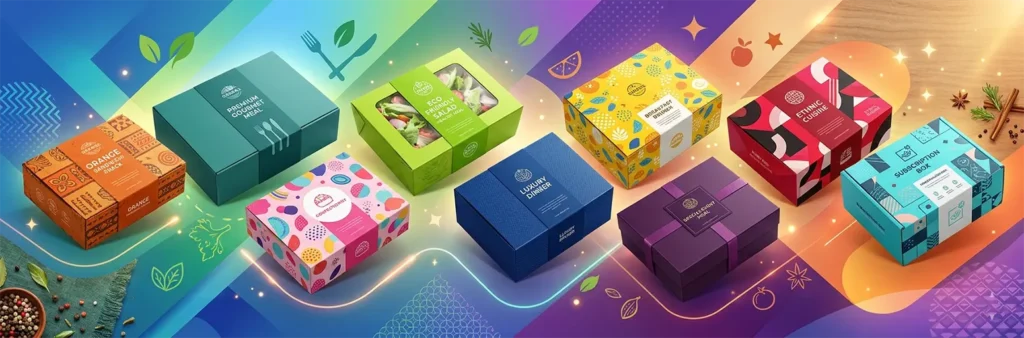
6. Food Box Packaging for Different Business Types
Best food box options for bakeries and pastry shops
Bakeries and pastry shops have unique food box requirements: the packaging must showcase the visual beauty of the product while protecting it from crushing, moisture, and temperature change.
Window food boxes — with a transparent acetate or PET window panel — are the gold standard for bakery packaging because they allow the product to sell itself visually while still providing full structural protection.
Custom bakery boxes with ribbon handles, magnetic closures, or multi-tier insert systems elevate the gifting experience and justify premium price points. The comprehensive article, Best Bakery Packaging Ideas Products: Keep Your Items Fresh & Attractive, covers the full range of bakery box options with guidance on which formats work best for different product types — from macarons to layer cakes to artisan bread loaves.
Restaurant takeaway food boxes that keep orders intact
For restaurants, the takeaway food box is an extension of the dining experience. A flimsy, leaking, or oversized takeaway box that arrives cold and soggy communicates the opposite of what your kitchen has worked to create.
Investing in high-quality, right-sized takeaway food boxes with grease-resistant lining and ventilation features (for fried foods) is a direct investment in customer satisfaction scores and repeat order rates.
The article Food Box Designs That Influence Restaurant Takeaway Sales documents how restaurant brands that upgraded their takeaway food packaging saw measurable improvements in customer review scores and online delivery platform ratings — a direct commercial return on a packaging investment.
Homemade food business packaging on a tight budget
Small and home-based food businesses often operate on tight margins, and the instinct is to minimize packaging costs. However, generic unbranded food boxes communicate low quality and make it almost impossible to build brand loyalty or justify premium pricing.
The good news is that affordable branded food packaging is more accessible than ever in 2026, thanks to print-on-demand services, low minimum order quantities, and digital printing technology.
Read budget guide, Cheap Food Packaging Ideas for Small Businesses (Budget-Friendly Guide), which covers practical cost-saving strategies including ordering through wholesale channels, choosing standard sizes to avoid custom die-cut costs, and using digital printing for short runs of branded food boxes. Budget constraints do not have to mean unbranded packaging.
7. FDA Compliance Essentials Specific to Food Box Packaging
Food-contact material requirements for printed food boxes
Food packaging that comes into direct or indirect contact with food must comply with United States Food and Drug Administration (FDA) regulations governing food-contact materials.
This is a non-negotiable legal and safety requirement — not an optional best practice. Food-contact packaging materials must not transfer harmful substances to food at levels that could endanger human health or cause unacceptable changes in the food’s composition, taste, or odor.
Under 21 CFR (Code of Federal Regulations) Parts 174–186, the FDA regulates indirect food additives — including adhesives, coatings, paper and paperboard components, and polymers used in food packaging.
Any ink, coating, laminate, or adhesive that comes into contact with the food or is used on the food-contact surface of a box must be either FDA-approved or manufactured from substances on the Generally Recognized as Safe (GRAS) list.
Labeling rules you must follow to avoid costly penalties
Beyond material safety, FDA regulations govern what information must appear on food packaging labels. For packaged food products, this includes the product name, net quantity statement, ingredient list (in descending order by weight), allergen declarations, nutrition facts panel (for most foods), and name and address of the manufacturer, packer, or distributor.
Failure to include required label information — or including false or misleading claims — can result in FDA warning letters, mandatory recalls, import alerts, and significant financial penalties.
The specific regulatory requirements for your food product category are detailed in our article Food Packaging Regulations in 2026: Complete FDA & Safety Compliance Guide, which also covers state-level requirements that may apply depending on your distribution geography.
For businesses selling in the European Union or United Kingdom markets, the European Food Safety Authority (EFSA) and UK Food Standards Agency (FSA) have their own food packaging material regulations that differ from FDA requirements in important ways.
If you are exporting food products internationally, always verify compliance with the destination market’s specific food contact material regulations.
8. Cost-Saving Strategies When Ordering Food Boxes in Bulk
MOQ strategies and negotiating with suppliers
Minimum order quantities (MOQs) are one of the most significant barriers for small food businesses looking to access custom food packaging. Suppliers typically set MOQs at 500 to 1,000 units for custom printed boxes, which can represent a significant upfront investment for a business that is still testing product-market fit or operating with limited working capital.
Effective MOQ negotiation strategies include: starting with a standard-sized food box to avoid custom die-cut tooling charges (which often add $300–$800 to your first order), combining multiple SKUs into a single print run with variable data printing (where the box structure is identical but artwork panels differ), and building a supplier relationship by placing smaller orders consistently before negotiating MOQ reductions on larger commitments.
The wholesale ordering channel offers significant per-unit cost savings for food businesses that have established consistent sales volume.
The article Wholesale Food Packaging: How to Save Cost and Scale Your Business provides a practical framework for transitioning from retail to wholesale food box purchasing, including how to evaluate supplier credentials, request samples, and structure payment terms that protect your cash flow.
Wholesale food box ordering vs. print-on-demand: a real comparison
Print-on-demand (POD) food box services allow businesses to order as few as 1–50 units of custom printed boxes, with no tooling costs and rapid turnaround (typically 3–7 business days).
This is ideal for product launches, limited editions, seasonal food boxes, and catering events. The trade-off is a significantly higher per-unit cost — POD food boxes typically cost 3–5 times more per unit than wholesale orders.
For established food businesses with predictable monthly volume of 200+ food boxes in a given size, wholesale ordering almost always delivers a lower total cost of ownership.
For new food businesses and those with highly variable seasonal demand, a hybrid approach — POD for launches and low-volume SKUs, wholesale for your bestsellers — offers the best balance of flexibility and cost efficiency.
9. Food Box Packaging Trends You Must Adopt Right Now in 2026
Smart packaging: NFC tags, QR codes, and interactive unboxing
Smart packaging technology is moving from innovation-lab curiosity to mainstream adoption in the food industry at remarkable speed. Near-field communication (NFC) chips embedded in food box panels allow consumers to tap their smartphone to the box and instantly access product origin stories, allergen information, recipe videos, loyalty rewards, or re-order links — creating a direct digital connection between your physical packaging and your digital brand ecosystem.
This category of packaging innovation is particularly powerful for premium food brands, organic and specialty food producers, and direct-to-consumer food businesses where provenance, transparency, and brand storytelling are core to the value proposition.
The cost of NFC-enabled food packaging has fallen significantly in recent years, making it accessible to mid-sized food brands for the first time in 2026.
For a comprehensive look at where packaging technology is heading, explore the article 10 Food Packaging Trends in 2025 That Every Restaurant Should Watch that covers emerging technologies including active packaging systems, time-temperature indicators, and compostable smart films — all of which are shaping the next generation of food box innovation.
Minimalist design and window boxes on the rise
Consumer preferences in food packaging aesthetics are shifting decisively toward minimalism. Cluttered, text-heavy food box designs are giving way to clean layouts with ample white space, single hero images, and restrained color palettes. This trend reflects broader shifts in consumer values toward authenticity, simplicity, and ingredient transparency.
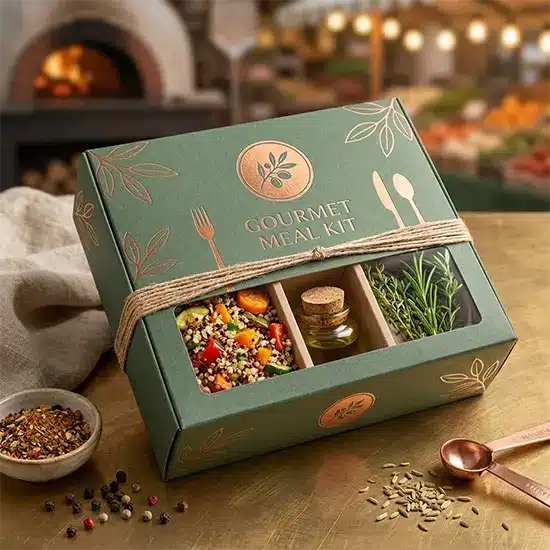
Window food boxes — featuring a die-cut opening covered with a transparent film — are experiencing a surge in popularity across bakery, confectionery, and specialty food categories.
The transparent window serves a dual purpose: it showcases the product’s visual appeal (supporting the sale), and it signals ingredient transparency and confidence in product quality (building trust). In a market crowded with me-too products, letting the food speak for itself through smart structural design is a powerful differentiator.
Sustainable packaging innovation in 2026
Beyond recyclable materials, food brands in 2026 are exploring compostable food box materials certified to ASTM D6400 standards, which break down in industrial composting facilities within 90 days.
Mushroom packaging (mycelium-based) is gaining traction for premium food gift boxes, where its unique texture and sustainability story command premium positioning. Water-soluble inner liners eliminate the need for plastic film inside food boxes while maintaining moisture and grease barriers.
Brands that make genuine sustainability commitments — and communicate them clearly on their food packaging — build stronger emotional connections with their target audience and enjoy measurable improvements in brand preference scores.
The key word is genuine: consumers are increasingly sophisticated at detecting greenwashing, and packaging claims that cannot be substantiated with certification and transparent supply chain data actively damage brand trust.
10. How to Order Custom Food Boxes
Step-by-step ordering process explained
Ordering custom food packaging to Packifyme is a streamlined process designed to take your brand from concept to finished, shelf-ready food boxes with complete support at every stage:
- Step 1 — Select your food box type: Choose from our full range of food box styles including window bakery boxes, corrugated takeaway boxes, rigid confectionery boxes, kraft gable boxes, tuck-end snack boxes, and more.
- Step 2 — Specify dimensions and quantity: Use our sizing guide or request a structural consultation if your product has non-standard dimensions. Provide your target quantity to receive an accurate per-unit price.
- Step 3 — Submit your artwork: Upload print-ready files (PDF, AI, or EPS) at 300 DPI with bleed and crop marks. Our design team reviews all artwork for print suitability at no charge.
- Step 4 — Approve your digital proof: We provide a full-color digital proof within 24 hours. Physical samples are available for orders above 500 units or upon request for new customers.
- Step 5 — Production and delivery: Once artwork is approved, your custom food boxes enter production. Standard lead times are 10–14 business days, with rush options available. All orders ship with full tracking.
Why packifyme.com is the trusted choice for custom food box packaging
Packifyme.com specializes in custom packaging across the full spectrum of packaging categories — including soap boxes, candle boxes, gift boxes, cosmetic boxes, rigid boxes, tuck boxes, tincture boxes, CBD boxes, and food boxes — giving us unique cross-category expertise that benefits every food packaging project.
Our food box clients benefit from food-grade material certification, FDA-compliant inks and coatings, structural engineering expertise, and a dedicated account management team that understands the unique demands of the food industry.
We work with businesses at every stage — from homemade food startups ordering their first run of 100 branded boxes to established food brands placing monthly wholesale orders of 50,000+ units. Our pricing is transparent, our quality guarantees are backed by a satisfaction commitment, and our design team is available to support brands that need creative assistance in addition to manufacturing.
Conclusion: Make Your Food Box Packaging Work as Hard as Your Food
In 2026, food box packaging is not an afterthought — it is a core strategic asset that directly influences sales, brand loyalty, customer satisfaction, and regulatory compliance.
The nine strategies outlined in this guide give you a comprehensive roadmap: from material selection and printing technique through branding, structural design, FDA compliance, cost management, and emerging packaging technology.
The food businesses that will lead their categories in the next five years are those that treat packaging as an investment rather than a cost — brands that understand that every food box they ship is a brand ambassador, a quality signal, and a customer experience moment that either builds the relationship or damages it.
For a deeper look at how smart packaging decisions translate into real commercial outcomes, read Packaging Case Study: How Smart Packaging Increased Product Sales — a real-world example of how a food brand achieved significant sales growth through a strategic food box packaging redesign.
Ready to transform your food box packaging? Visit packifyme.com today to explore our full range of custom food box solutions, request a free sample pack, or speak with one of our food packaging specialists about your specific requirements.
Frequently Asked Questions: Food Box Packaging
Q1: What is food box packaging and why does it matter for my business?
A: Food box packaging refers to any rigid or semi-rigid container — made from materials such as kraft paperboard, corrugated board, or rigid chipboard — specifically designed to hold, protect, transport, and display food products.
Unlike flexible packaging (pouches, films, wraps), food boxes provide structural protection, stackability, and premium branding surfaces that directly influence how customers perceive your product’s quality and value.
For food businesses of all sizes — from home bakers to restaurant chains — food box packaging matters because it performs three simultaneous jobs: it protects the food from physical damage, moisture, and contamination; it communicates your brand identity at every customer touchpoint; and it must comply with food safety regulations that govern what materials can legally come into contact with food.
Businesses that invest strategically in custom food box packaging consistently see higher perceived value, stronger brand recall, and measurable improvements in repeat purchase rates.
Read more: Food Box Branding That Increases Shelf Appeal — packifyme.com
Q2: What materials are used in food-grade box packaging?
A: Food-grade box packaging must be made from materials certified safe for food contact — meaning they cannot transfer harmful substances to the food at levels that could pose a health risk. The most commonly used materials for food boxes are:
- Kraft paperboard: A natural, unbleached paper material that is food-safe, recyclable, and biodegradable. Ideal for bakery boxes, takeaway boxes, and artisan food packaging.
- Corrugated board (single or double wall): Offers superior structural strength and insulation. Used for pizza boxes, meal delivery boxes, and hot food takeaway packaging.
- Rigid chipboard: Premium, dense board used for luxury confectionery boxes, gift food sets, and high-end bakery packaging. Provides a premium unboxing experience.
- Bagasse (sugarcane pulp): An eco-friendly, compostable alternative gaining popularity for sustainable food brands in 2026.
All inks, coatings, and laminates applied to food boxes must also comply with food-safe standards. Water-based inks and FDA-approved coatings are the industry standard for food contact packaging materials.
Read more: Kraft Food Packaging: Benefits, Uses, and Why It’s So Popular — packifyme.com
Q3: Are custom food boxes FDA compliant? What should I check?
A: Custom food boxes must comply with U.S. Food and Drug Administration (FDA) regulations that govern food-contact materials. The FDA regulates indirect food additives — including the paper, paperboard, coatings, inks, and adhesives used in food box manufacturing — under 21 CFR (Code of Federal Regulations) Parts 174–186. Compliance means:
- The base material (paperboard or corrugated board) must be food-grade and free from contaminants that could migrate into the food.
- All printing inks must be food-safe — either applied on the non-food-contact side of the box or formulated to prevent chemical migration through the board.
- Coatings and laminates (gloss, matte, UV) must comply with FDA food contact substance approvals.
- Recycled content materials must be certified free from harmful substance carry-over from previous use cycles.
When ordering custom food boxes from any supplier, always request food-grade material certification documentation and confirm that the inks and coatings used are FDA-compliant.
At Packifyme, all food box materials meet FDA food contact requirements as standard.
Official Government Reference: FDA Food Contact Substances — https://www.fda.gov/food/food-ingredients-packaging/packaging-food-contact-substances
Q4: What is the minimum order quantity (MOQ) for custom printed food boxes?
A: Minimum order quantities for custom printed food boxes vary depending on the supplier, box style, and printing method. As a general industry guide:
- Digital printing: MOQs as low as 50–100 units. Ideal for startups, product launches, and limited-edition seasonal food boxes.
- Offset printing: MOQs typically start at 500–1,000 units. Offers the highest color accuracy and is most cost-effective at scale.
- Flexographic printing: Used for corrugated food boxes at high volumes. MOQs typically 1,000+ units.
For new food businesses or those testing new packaging designs, print-on-demand digital food boxes allow branding without large upfront inventory commitments.
For established food brands with consistent monthly volumes, wholesale ordering at higher MOQs delivers significant per-unit cost savings — typically 40–70% cheaper than print-on-demand pricing.
Read more: Wholesale Food Packaging: How to Save Cost and Scale Your Business — packifyme.com
Q5: How do I choose the right size for my custom food box?
A: Choosing the correct food box size is critical for product protection, cost efficiency, and unboxing experience. A box that is too large allows the food to shift during transit — potentially damaging the product, creating a poor first impression, and increasing void fill costs.
A box that is too small risks crushing or damaging the food and creates a frustrating customer experience.
Follow these steps to determine the right food box size:
- Measure your product at its widest points (length × width × height) with a small tolerance of 0.25″–0.5″ on each dimension for easy insertion and removal.
- For foods with toppings, decorations, or fragile surfaces (such as decorated cakes or cream-topped pastries), allow additional height clearance of at least 1″–1.5″ to prevent lid contact.
- For delivery food boxes, consider the stacking weight of multiple boxes and choose structural grades (double-wall corrugated) that maintain integrity under stacking pressure.
- For retail shelf food boxes, standard sizing ensures compatibility with common shelf dimensions and avoids wasted shelf space.
Packifyme offers both standard and fully custom-sized food boxes. Our packaging consultants can advise on the optimal structural format for your specific product and distribution channel at no extra charge.
Q6: What printing options are available for custom food boxes?
A: Custom food boxes can be printed using several techniques, each suited to different volumes, quality requirements, and budgets:
- Digital printing: No plate setup costs. Fast turnaround (3–7 days). Best for short runs (50–500 units). Full-color printing with variable data capability (ideal for personalized food boxes or seasonal editions).
- Offset lithography: Highest color accuracy and consistency. Best for 500+ unit runs. Requires printing plate setup but delivers the most vibrant, true-to-pantone color output.
- Flexographic printing: High-speed, cost-efficient for large corrugated food box runs (1,000+ units). Slightly lower resolution than offset but ideal for bold, simple designs.
Surface finishing options that enhance the impact of printed food boxes include matte lamination (soft, premium feel), gloss lamination (vibrant, high-shine), spot UV (selective gloss highlights on matte background), embossing and debossing (tactile raised or recessed design elements), and foil stamping (metallic gold, silver, or custom color accents for luxury food packaging).
Read more: 5 Powerful Food Box Printing Techniques That Boost Brand Recall — packifyme.com
Q7: How can food box packaging help keep food fresh longer?
A: The right food box packaging actively extends freshness by creating a physical barrier against the environmental factors that cause food deterioration: moisture, oxygen, light, and temperature fluctuation. Here is how different food box design elements contribute to freshness:
- Moisture-resistant coatings and lining: Grease-proof and moisture-resistant inner coatings prevent the box material from absorbing moisture from the food (which can cause sogginess) or allowing external moisture to penetrate and damage the food.
- Tight-fitting closures: Tuck-end boxes with locking tabs, magnetic closures on rigid boxes, and friction-fit lids on window boxes all minimize air exchange, slowing oxidation and maintaining freshness.
- Ventilation features: For hot fried foods, strategically placed micro-perforations or ventilation tabs in food box designs allow steam to escape, preventing condensation that would make fried food soggy.
- Insulated corrugated construction: Double-wall corrugated food boxes provide a thermal barrier that slows heat loss for hot food delivery and slows temperature gain for cold or chilled food packaging.
Read more: Food Packaging That Keeps Freshness Longer (Scientifically Proven) — packifyme.com
Q8: What are the best eco-friendly food box packaging options in 2026?
A: Sustainable food box packaging is one of the fastest-growing priorities for food brands in 2026, driven by consumer demand, Extended Producer Responsibility (EPR) legislation in states including California, Maine, and Oregon, and global PFAS restrictions on chemical coatings in food packaging.
The best eco-friendly food box options available in 2026 include:
- Recycled kraft paperboard: Made from post-consumer recycled fiber. Fully recyclable and widely accepted in municipal recycling programs. Available with food-safe water-based ink printing.
- Bagasse (sugarcane pulp) boxes: A byproduct of sugar production. Compostable in industrial facilities. Excellent moisture resistance for hot and wet food applications.
- FSC-certified virgin fiber boxes: Sourced from responsibly managed forests. Recyclable and certified to Forest Stewardship Council standards — a strong brand signal for eco-conscious food brands.
- PFAS-free food boxes: Grease resistance achieved through PFAS-free barrier coatings (fluorine-free alternatives). Increasingly required under state law and preferred by health-conscious brands.
- Compostable window film: Replacing traditional PET acetate windows in window food boxes with PLA (polylactic acid) compostable alternatives — maintaining product visibility while eliminating plastic.
Read more: Eco-Friendly Food Packaging Solutions: Sustainable Options for 2026 — packifyme.com
Q9: How much does custom food box packaging cost?
A: The cost of custom food box packaging depends on four main variables: box style and structural complexity, material grade, print method and number of colors, and order quantity. As a practical benchmark for 2026:
- Simple kraft tuck-end food boxes, digital print, 100 units: Approximately $1.80–$3.50 per unit.
- Standard window bakery boxes, offset print, 500 units: Approximately $0.90–$1.80 per unit.
- Corrugated takeaway food boxes, flexographic print, 1,000 units: Approximately $0.50–$1.20 per unit.
- Premium rigid food gift boxes with ribbon handle, offset print + foil stamping, 500 units: Approximately $3.50–$7.00 per unit.
These are industry reference ranges — actual pricing varies by supplier, design complexity, and current material costs. Key cost levers include: choosing standard sizes over custom die-cut dimensions (saves tooling charges of $200–$800 per order), increasing order quantity (each doubling of quantity typically reduces per-unit cost by 20–35%), and selecting digital over offset printing for runs under 300 units.
Read more: Cheap Food Packaging Ideas for Small Businesses (Budget-Friendly Guide) — packifyme.com
Q10: How is food box packaging different from other packaging types like cosmetic boxes, soap boxes, or rigid boxes?
A: Food box packaging shares structural and printing fundamentals with other packaging categories — such as cosmetic boxes, soap boxes, candle boxes, gift boxes, rigid boxes, tuck boxes, tincture boxes, and CBD boxes — but is uniquely governed by food safety regulations that apply to no other packaging category. The key differences are:
- Material safety standards: Food boxes must use food-grade, FDA-compliant materials and inks. Cosmetic boxes, soap boxes, and candle boxes have no food-contact material requirements — they can use a wider range of inks, coatings, and materials without regulatory restriction.
- Grease and moisture resistance: Food boxes frequently require grease-resistant coatings or liners to prevent oil and moisture migration through the box wall — a requirement absent in non-food packaging categories like rigid boxes for electronics or tuck boxes for cosmetics.
- Freshness and barrier engineering: Food box design must account for oxygen transmission, moisture vapor transfer, and temperature management. These functional requirements do not apply to candle boxes, gift boxes, or CBD boxes, which are engineered purely for product protection and aesthetics.
- Regulatory labeling: Food boxes must carry mandatory FDA labeling elements including ingredient lists, allergen declarations, and nutrition facts. Cosmetic boxes are governed by different FDA labeling rules, while CBD boxes and tincture boxes face their own regulatory frameworks under both FDA and state-level cannabis regulations.
At Packifyme, we manufacture across all packaging categories — food boxes, cosmetic boxes, soap boxes, candle boxes, gift boxes, rigid boxes, tuck boxes, tincture boxes, and CBD boxes — giving our food packaging clients the benefit of cross-category structural and design expertise that specialist food-only suppliers cannot offer.
Read more: Food Packaging Regulations in 2026: Complete FDA & Safety Compliance Guide — packifyme.com
Have more questions about custom food box packaging?
Visit packifyme.com to speak with a packaging specialist, request a free sample pack, or get a custom quote for your food box packaging project.