
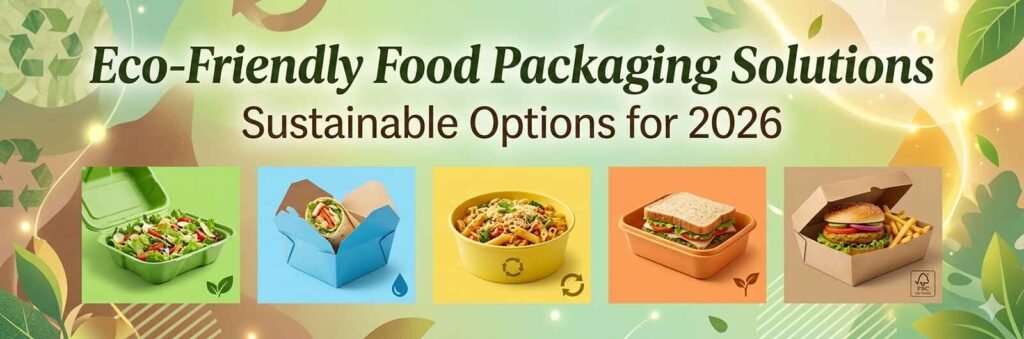
Eco-Friendly Food Packaging Solutions: Sustainable Options for 2026
What is Eco-Friendly Food Packaging?
Eco friendly food packaging is more than just a trend; it is a smarter and more responsible way to serve and store food without harming the environment. Designed with sustainable materials and mindful processes, it reduces waste, saves resources, and minimizes pollution from the moment it is created to the time it is disposed of. At the same time, it ensures your food stays fresh, safe, and high in quality, proving that you do not have to choose between convenience and care for the planet, you can have both in one thoughtful solution.
More generically, eco-friendly packaging is the one which compostable products, biodegradable materials, recyclable materials, and reusable resources. Examples include: kraft paper, cardboard, PLA (a kind of plastic made from plants), glass, and metal containers. Unlike plastic packaging that takes hundreds of years to decompose, eco-friendly packaging can easily decompose under natural elements or through common reusing.
Eco-friendly packaging for food has some of the following features, among which sustainability is a key attribute. This means that the materials are responsibly sourced, mainly from renewable sources, and produced in low-carbon processes. For instance, paper-based packaging is sourced from sustainably managed forests, and the compostable packaging is plant-based (like cornstarch or sugarcane), where the end result actually fits into nature.
Another important aspect is safety. Food-grade requirements for eco-friendly packaging regulation still apply, which must prove that they do not decompose or alter the quality of food. This solves for a commercial need as much as it does an environmental one.
Eco-friendly packaging is not just a trend; it is practically a new method to minimize environmental impact without failing modern consumer expectations. With a realization in the business heads regarding all that sustainability is about, these packaging solutions become one of the keys for a business to be standing tall against its competitors and making itself responsible and eco-friendly at least till 2026.
Why Sustainable Packaging Matters in 2026
As per reports of 2026, green packaging gets a lot of attention because of environmental issues, more stringent laws and regulations associated with it, as well as a shift in consumer habits. The drive away from plastic food packaging is motivated by the need to cut down on plastic waste, save natural resources, and reduce carbon emissions.
Waste management is a global problem, and the primary reason sustainable packaging becomes so important. Conventional packing with single-use plastics is one of the leading causes of environmental pollution. Waste is overflowing landfills, and plastic garbage threatens ecosystems and wildlife. This means that the eco-friendly packaging solution comes one step ahead of this issue as it provides materials that are recyclable, compostable, or reusable.
A second key factor is consumer awareness. 1 Environmentally Conscious Consumers:Brand stories and attributions are more aware of sustainability in concern to customer profiles, and the modern buyer is forced to prefer brands that practice it. Eco-friendly packaging creates strong trust, improves the brand image, and attracts a higher customer base.
Regulations are also becoming stricter. Regulatory organizations and governments are starting to regulate the ban on non-recyclable substances while promoting the use of environmentally friendly alternatives. This implies that there will be on business which fails to transform themselves penalties and/or limitations.
So not only is sustainable packaging cost-effective in the long run. While some of the different ways for going green have increased costs in the short-term, diminished wastage, more efficiency, and improved brand value lead to better profitability over time.
In conclusion, in 2026, eco-friendly packaging is no longer an option; it is a necessity. Sustainable packaging helps businesses to demonstrate commitment towards environmental conservation; therefore, it is inevitable that there will be an increased demand for opt-in packaging in the future as it empowers brands with a competitive edge for long-term sustainability.
Benefits of Eco-Friendly Food Packaging
Below are following benefits of eco-friendly packaging.
- Environmental Impact Reduction
The environmental effects are one of the most important parts of eco-friendly packaging. By contrast, traditional packaging materials can be highly polluting and wasteful for landfills, especially single-use plastics, which have a devastating impact on our ecosystems. Face off with sustainable packaging designed for minimal waste and carbon footprint.
Examples of the easier-to-decompose materials include biodegradable plastics, recycled paper, and compostable containers — basically anything made from natural matter does not stick around as long in the environment. It not only reduces landfill overflow but also minimizes the risk of polluting oceans and natural ecosystems. Additionally, various sustainable materials utilize renewable material biomass that helps reduce reliance on fossil fuels.
Another essential component of the equation is lowering carbon emissions. Sustainable packaging generally requires less energy to manufacture and transport, resulting in a smaller carbon footprint. It goes without saying that eco-friendly packaging is a product that can and will be purchased by businesses; however, a business that chooses eco-friendly packaging also supports the conservation of the environment.
So that was all about the eco-friendly packaging options and how switching over to green packaging helps in saving the planet from waste, resource depletion, and eco-harm.
- Improved Brand Image and Customer Trust
If anything, eco-friendly packaging can provide a brand value that could shoot it to the moon and build one of the most powerful trusts with its customers. In this world, consumers have a good sense of environmental issues and prefer responsible companies that practice a sustainable way.
When a business becomes greener and changes to eco-packaging, they are telling the world at large that they care about both its environmental responsibility and its corporate social responsibility. As a result, a positive sentiment towards your brand can be created, and customers can have an emotional connection with you. This, in turn, incentivizes customers to choose to switch and stay loyal to those brands.
In addition to the sustainable packaging benefits, it also delivers marketing upsides. It also allows businesses to emphasize sustainability as a competitive advantage. Even simple things like recycling labels or biodegradable materials can throw haymaker punches.
It also gives transparency by being upfront with packaging decisions. Honesty regarding sustainability is important to consumers, and with honesty comes loyalty, translating into continuous purchases from brands.
Secondly, aside from sustainability, eco packaging is a way to create your brand and communicate with customers.
- Compliance with Packaging Regulations
Eco-friendly packaging will also create compliance with the regulations. Various governments and regulatory authorities around the world are launching policies for reducing environmental impact using sustainable packaging practices.
Around the world, the ban on nonrecyclable plastics and waste and stringent material cleanliness standards have become an integral part. Choosing to go green is always a great idea, and in this specific case, it keeps businesses away from falling afoul of government environmental impacts that can lead to heavy penalties for non-compliance.
Environmentally sustainable materials are often manufactured according to environmental and food safety regulations. It also ensures that the packaging is non-toxic and compliant with regulations. The firms that adopt alternative packaging ahead of their competitors will be most ready for future regulatory changes.
Not only does this, but the compliance also enhances the business image. When a business abides by the regulations, it makes a name for itself as a responsible organization in front of customers, partners, and authorities.
In short, eco-friendly packaging is the best choice for companies in order to comply with their legal obligations or achieve some of their sustainability objectives.
Best Eco-Friendly Food Packaging Solutions in 2026
Here are following eco-friendly packaging solutions in 2026
- Biodegradable Packaging Materials
Biodegradable materials are among the most popular options regarding eco-friendly packaging. These will, over time, be degradable in nature and will not leave behind residual chemicals that poison the environment.
More common biodegradable packaging options include some bioplastics, paper-based products, and plant-based materials. They are ideal for running businesses that do not want to sacrifice quality and would like lower waste.
Its packaging also helps to not fill the landfills with waste, making it especially helpful for everything that can be considered single-use. This is a workable, long-term solution for food businesses today.
- Compostable Food Packaging Options
Compostable Packaging– a really huge component of Eco-friendly packaging. Biodegradable materials are not safe enough to be held for a long time, but compostable packaging decomposes into natural elements through microbial action, leaving no toxicity in the environment.
Cornstarch containers, sugarcane fiber (commonly referred to as bagasse), and PLA plastics are common materials used in compostable packaging. Industrial composting plants are able to treat it, thus transforming waste into an emerging commodity301.
Compostable packaging is ideal for a business that wants to promote its zero-waste initiative and bring in customers who are environmentally conscious.
- Recyclable Packaging Solutions
The main reason why recyclable packaging can be a help in eco-friendly packaging is that it gives reusable material and avoids the disposal of them. e.g., paper, cardboard, glass, and some plastics.
Recycling conserves natural resources and reduces the waste of new raw materials. It also cuts energy use and environmental harm.
This indicated packaging can guide enterprises in supporting recycling and also promote secure disposal of material.
- Kraft Paper and Cardboard Packaging
Kraft paper and cardboard — cost-effective, eco-friendly packaging material, recyclable, and tailored for the transfer of goods to consumers. These are strong, lightweight materials that can be used with a wide range of food products.
Kraft paper also gives a natural and organic vibe that works well with eco-friendly branding. It is very easy to customize, just a simple pattern using water-based inks.
This is because they are biodegradable, recyclable, and offer a middle ground between ecological soundness and practicality.
- Plant-Based Packaging Materials
Another type of innovative, eco-friendly packaging is plant-based packaging, made from renewable resources like cornstarch, sugarcane, and bamboo. They are replicating mainstream plastics to serve similar purposes.
Alternative packaging materials that are biodegradable or compostable can come from plant derivatives. More specifically, it’s great for things like disposable food containers, utensils, and wraps.
Due to technological advancements and a relatively inexpensive infrastructure in place, plant synthetics are gaining popularity, making them more accessible for small businesses as well.
- Edible Packaging Innovations
Edible packaging is one of the most evolving trends in eco-friendly packaging. It is a food-grade packaging that is safe to be eaten with the product.
The edible films, wraps, and coatings are made from seaweed, rice, or starch. Deliver a standout solution that is net zero in packaging waste.
While edible packaging is still in its infancy, it certainly has the potential to reduce the carbon footprint of packaging and offer brand equity through an enhanced customer experience.
- Reusable Packaging Solutions
The reusable clothing is possibly the most practical option in eco-friendly food packaging. These packaging solutions are meant to be reused multiple times instead of being discarded after the first use.
These can be glass jars, metal tins, or plastic boxes. Investigate other companies that allow consumers to bring back their packaging for reuse, facilitating a closed loop.
But reusable packaging is one way to help the planet while also saving you money in the long-run! Greening is perfect for organizations that cannot avoid producing profits, but at the same time, they are committed to achieving ecological sustainability.
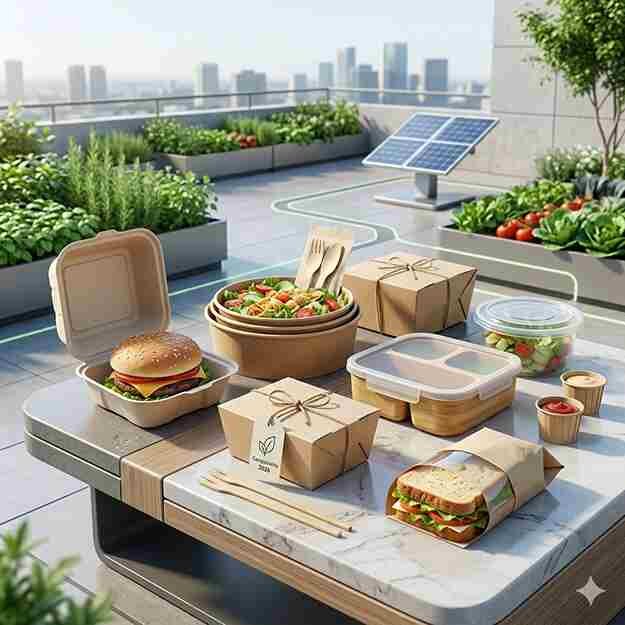
Types of Sustainable Packaging Materials
Here are following types of sustainable packaging materials.
- Paper and Cardboard
Natural food packaging products are paper and cardboard; they are easy to source, recycle, and also economical. These are often based on renewable raw materials like wood pulp and can undergo several recycling cycles to avoid the demand for new virgin material.
Paper-based packaging is a great option for various dry foods, bakery goods, and also to meet the takeaway packaging requirements. Cardboard boxes provide structural integrity; however, paper wraps and bags are incredibly lightweight and flexible. Additionally, Kraft paper is exceptionally environmentally friendly due to its biocompatibility; they decompose much quicker than plastic.
While, on the contrary, paper and cardboard packaging can be gorgeous to meet their needs, custom-affordable utilizing herbal inks with much less designing helps sustainable branding. Many manufacturers now use materials from responsibly sourced forests certified by environmental organizations that verify sustainable forestry practices.
As per the United States Environmental Protection Agency (EPA) Recycling Facts, paper and paperboard products are among the highest recyclable materials, with upwards of 90% recycling rates.
Broadly speaking, paper and cardboard are still a practical and much more economical packaging alternative for eco-friendly food packaging.
- Bioplastics and PLA
More recently, though, certain newer materials have been developed with compostable and environmentally friendly food packaging in mind, such as bioplastics, such as polylactic acid or PLA. According to the definition currently in use, these materials are produced from renewable resources (such as cornstarch, sugarcane, or other plants), and they can have an additional classification that qualifies them as an alternative material to petroleum-based plastics.
Most often, PLA is applied for food containers, cups, and packaging films. It has the durability and transparency of traditional plastic but comes with a smaller environmental footprint. PLA can be industrially composted, which means under industrial conditions, it will turn back to – well, natural elements that don’t really cause a hazard.
Bioplastics are a very good alternative to fossil fuels, leading to lower carbon emissions. For instance, some bioplastics decompose only in specific industrial composting plants, and this is why proper disposal is crucial.
The growing interest in sustainable plastic substitutes and incomplete advice from researchers and regulators highlights the need to consider something other than environmental harms.
Both bioplastics and PLA represent an advanced packaging solution for companies that have sustainability of their packaging among their objectives.
- Glass and Metal Packaging
Glass and metal containers, for example, are another set of food packaging that belongs to this category as they are, by nature, highly durable and sustainable. They do not react and are non-toxic, unlike plastic, which degrades the quality of food that is stored in them.
That is also the reason why glass, which does not react with the contents, is widely used for drinks, sauces, and preserved foods. It is also 100% recyclable and can be reused more than 100 times without regaining its properties. Metals, too, like aluminum and steel (there are tons of them out in the world, just go ask your parents about cans and containers), tend to be strong, lightweight, and easily recyclable.
The glass and metal may very well be one of the best things because it lasts. Unlike single-use materials, they are forever recyclable; they are more environmentally sound and keep resources in the loop. However, businesses will be best served to factor in their move weights that may tip the scales.
Eco-friendly data proves that metals and glass are among the most recyclable materials utilized in packaging.
To conclude, glass and metal closures are a sustainable product packaging option for items that require considerable protection and extended shelf life.
How to Choose the Right Eco-Friendly Food Packaging
By following all methods described below you can choose the right eco-friendly food packaging.
- Consider Food Type and Shelf Life
What we are looking for in selecting the best eco-friendly food packaging is to know and understand what kind of food it will be, and then what the shelf life will be. Food packaging helps to keep food products safe, fresh, and of high quality.
Some of the kibbles can be placed in paper or cardboard packaging; liquids and foods that spoil should use stronger materials, such as bioplastics or possibly glass. The style of packing should also function as a moisture, oxygen, and pathogens barrier.
Shelf life is something else to keep in mind. Packaged goods, particularly perishables, should be packed to withstand the wrath of various environmental factors for an extended period. But for short-term products, cheaper and basic materials can be taken advantage of.
Food safety rules stipulate that selected packaging has to be suitable for what it is used for.
Arguably, one of the most effective ways to do that is by ensuring packaging materials match food type and shelf life properly.
- Evaluate Cost vs Sustainability
The objective is to strike a balance between cost and sustainability in eco-friendly food packaging. Although eco-friendly materials might have a higher initial cost than their non-eco-friendly counterparts, ultimately, it saves overall cost by reducing waste, improving brand image, and complying with the regulatory environment.
Calculating costs: companies have to think about the final cost of packaging from its production through storage and transportation. Limiting shipping materials that are heavy (those of lesser weight) and that are recyclable can lower the overall cost to a firm over time; alternatively, providing packages that are reusable will reduce long-term expenses.
Then, you have to account for the cost of sustainability. The eco-friendly urges of one consumer group can also attract customers to sustainable packaging and, in return, this generally ensures brand loyal along poise long time sale.
Long-term value-driven cost management strategies, as opposed to cost retention in the short run
In conclusion, economic is only as far as the budget allows and is reliable only where it upholds sustainability.
- Check Certifications and Standards
Verifying Certificates & Standards is one of the important steps in choosing eco-friendly food packaging. Companies and consumers can have peace of mind knowing that packaging materials are carefully produced when considering environmental and food safety certifications.
Including certifications for food-grade approval, composability certifications, sustainability labels, and everything in between. Such certifications guarantee that materials are appropriate for food contact and meet environmental requirements.
Having certified packaging is essential for compliance, as businesses need to steer clear of legal problems. Another advantage is the heightened credibility, where there is a tendency for consumers to trust more in products that fall in line with certain standards (Sharma et al.,2017).
That’s why our regulators are so adamant that fields meet the requirements of food packaging safety.
In summary, certifications and standards are an essential component of sustainable food packaging that make it harmless for the consumer.
Cost of Eco-Friendly Food Packaging in 2026
One of the most frequently asked questions by businesses is whether eco-friendly food packaging, asks Arjun Sharma. Material, scale, and level of customization all dictate the answer. Although previous years had sustainable packaging that was affordable to create, 2026 has taken that up a notch and made it even more affordable, although possible providers may incur a small additional fee for traditional packaging.
The more complex the production processes and the less likely that mass-producing these products is, results in high prices like biodegradable and compostable materials. Small businesses can start with low-cost, commercially available options from kraft paper to cardboard and some higher-recyclable materials.
This perception of higher cost comes primarily from comparing eco materials with the most inexpensive commodity, conventional plastics. When businesses consider the total value, which includes environmental impact, brand impression, and compliance, eco-friendly food packaging is a relatively cost-effective investment.
And with demand increasing, production costs are declining, which makes sustainable packaging increasingly affordable for companies big and small.
Bottom Line: While there will still be a higher up-front cost for some green products, most economical solutions have entered the marketplace, making 2026 the year for sustainable packaging that customers and brand owners support.
- How to Reduce Costs with Eco Packaging
Green food packaging is a perfect combination of business and environmental policies; companies can cut costs by using intelligent strategies + best practices. Buying in bulk is one of the best ways to lower the per-unit price and get a continuous supply of packaging material.
One of the solutions for this can be to go in a minimal and simple way with designs. It can reduce the cost by avoiding overprinting, layers, and fillers. Cargo specs and packaging measuring systems, along with containers that may be used a number of times, keep costs down while streamlining operations and water management processes.
A further way to get savings on consumer goods is by using more locally harvested material. It lowers transportation costs and enables faster supply chains. Provide companies with the chance to work with suppliers and find affordable sustainability solutions that align with their budget while helping them meet sustainability goals.
Reducing waste is equally important. By maximizing pack size and minimizing wasted packaging, companies save on material costs and move products more efficiently.
Last but not least, you can incorporate the practices of eco-friendly food packaging TB without breaking the bank, i.e., bulk purchases, in addition to reducing designs and saving wastage.
- Long-Term Cost Benefits
Eco-friendly food packaging, even if expensive in a few cases, is profitable and reduces environmental impacts. One of the core advantages is cost savings via waste reduction. These perspectives help you keep the additional expenses at bay and hence, save money that is spent on resources like something that is made from sustainable packaging, which comes with less material and is almost all recyclable or reusable.
Another benefit is the identification of increased brand value. The eco-friendly packaging options can invoke an environmentally-conscious set of customers to buy your products, thus helping you sell and build customer loyalty. This will result in long-term increased revenue that addresses the original costs.
Regulation adherence is another long-term metric. Businesses that engage in the use of sustainable packaging are less likely to incur punishment or pay out expensive adjustments, as far more Earth-helpful laws exist at any time-dependent horizon.
In addition, reusable and durable packaging reduces the need for companies to change it (which helps companies save money in the process). Packaging of the products can also address shipping costs with compact and lightweight packages.
In other words, eco-friendly food packaging is an investment, thus providing a very good return on money in the long run, leading to becoming a better brand and sustainable growth.
Challenges of Eco-Friendly Food Packaging
The biggest disadvantage of eco-friendly food packaging is its higher cost vs conventional packaging in the initial phase. Some of the sustainable materials, like compostable plastics or plant-based packaging, require more complex manufacturing processes, which increase production costs.
- Higher initial cost
If it requires a high up-front investment, this could be a hindrance for smaller organizations that run on tight budgets. But this cost should be viewed as a long, multistep process, rather than buying and paying the last price in a ready manner. Prices are slowly improving with the market demand increase and producing gradually increasing.
This challenge can be addressed by selecting one inexpensive eco-material (e.g., any package based on paper) and slowly transitioning to more complicated materials over time.
- Limited Availability
One of the issues with ecologically friendly food packaging is that it may not be easy to find in some areas or for some types of materials. Not all suppliers will have an entire range of packaging, making it challenging to discover sustainable packaging.
Additionally, when companies use specialized sources or imports to acquire materials, the costs may be higher and delivery times longer.
However, with sustainability among the agenda of governments across the world, getting readily available eco-friendly packaging is far better. There is a growing demand, but more suppliers are entering the market, and distribution networks are expanding.
Networking with reliable suppliers and alternate sourcing can be the right way of dealing with this problem, because it may ensure consistency in supply.
- Performance and Durability Issues
Issues that exist regarding eco-friendly food packaging are in the performance and durability. New Age sustainable materials simply will not provide the necessary strength, moisture resistance, or shelf-life prevention effect that plastic may have apparently successfully gotten away with for decades.
Which notes that: a bioplastic will decompose more quickly, and even compostable material may lose its properties under certain circumstances. So, what can we do about the fact that something like a liquid or hot food item, for example, cannot just be added and therefore needs to be packaged in such a way that it would remain as is longer, i.e., optimal shape, at longer shelf lives?
To help avoid these issues, companies must select materials that fit their molds. The additional data from tech developments is additionally aiding the enhancement of effectiveness fundamentals of green materials, and complementarity aids in their seal reliability range.
But before packaging can be produced on a large scale, you have to test the quality and safety of it. As long as businesses are intentional about selecting their materials and providers, durable goods issues can be controlled.
FAQs About Eco-Friendly Food Packaging
What is Eco-Friendly Food Packaging?
A solution such as eco-friendly food packaging brings in the use of technology to derive out packaging materials which are environmentally sensitive and provide security, yet keep it quite simple for keeping its usefulness. They are usually made with biodegradable, compostable, recyclable, or reusable products.
In reality, they are all composed of recyclable items — kraft paper, cardboard, bioplastics, and glass containers. Eco-friendly food packaging aims at reducing waste, avoiding wastage of resources & making the practice sustainable, unlike plastic food packaging.
Customer preferences and government required Eco-friendly packaging have become a staple for companies by 2026.
Is eco-friendly packaging safe for food?
Let us ask the important question: are eco-friendly food containers safe for eating? These materials are designed, developed, and purposely tested for food contact, with no risk of the transfer of harmful substances.
The food industry has many widely used items of food-grade paper, compostable containers, and plant-based plastics. The solution is to have a Packaging supplier who has the correct certification.
What materials are biodegradable?
Biodegradable packaging is made from a variety of natural materials, including kraft paper and cardboard, as well as other bioplastics and natural fibers such as bamboo or bagasse (the raw material remaining after extracting the juice from sugarcane). This means these materials degrade naturally after a period of time without toxic traces.
Biodegradable packaging will make landfills and environmental pollution history. However, the rate and level of decomposition are still highly influenced by environmental factors like temperature or humidity.
And the simplest way to go green is just to make your choice of materials biodegradable.
Is sustainable packaging expensive?
In some cases, eco-friendly packaging materials can cost more than conventional packaging, but this is not necessarily a rule. There are several eco-friendly food packaging products to choose from, with paper and cardboard being affordable and readily available.
On top of that, it results in future savings as waste incurs disposal costs, improves the company’s image, and sells or rents itself to comply with regulations. These advantages might offset any initial cost and increase long-term profitability.
Utilization of bulk delivery, minimalistic design, and multi-application packaging solutions will also allow any business to save on production and logistics costs.
How can small businesses switch to eco packaging?
Therefore, you can consider small steps with pragmatism to shift towards eco-friendly food packaging for your small businesses. What comes next is the first step towards alternative materials like paper, cardboard, or biodegradable containers.
Second, companies should ask themselves how much packaging they actually need and get rid of any unnecessary material to reduce waste and costs. An equally important aspect is dealing with trusted suppliers with eco-friendly alternatives.
Just small changes — switching your packaging to recyclable or putting an eco-label on it can go a long way already. As good applied science, and will reconstruct work, the formula became integrated, a firm can deploy bigger maintainable instruments.
The final conclusion is that moving from conventional to green packaging does not need a system transformation. With the right approach, small businesses can enter it seamlessly and affordably.
How and where to buy eco-friendly food boxes?
Below are a few reliable options if you want to buy eco-friendly food boxes, including wholesale suppliers, online marketplaces, and specialty packaging companies. It is important for small businesses to have a supplier offering good quality at the right price point.
One recommended option is PackifyMe. To know more about eco-friendly food packaging, visit: An industry leader that builds an entire world of solutions tailored to small business needs and uses environmentally friendly materials & is available at com. Provide kraft boxes, recycled nature & cheapest custom patterns corresponding with up-to-date sustainable purposes.
When buying food boxes, keep in mind that these packaging materials should be food-grade and eco-friendly, as well as applicable to the type of product you want. Buying in bulk also generally reduces cost and increases uniformity.